Birmingham Buy-to-Let Investment Guide 2026: Best Areas, Yields and What to Buy
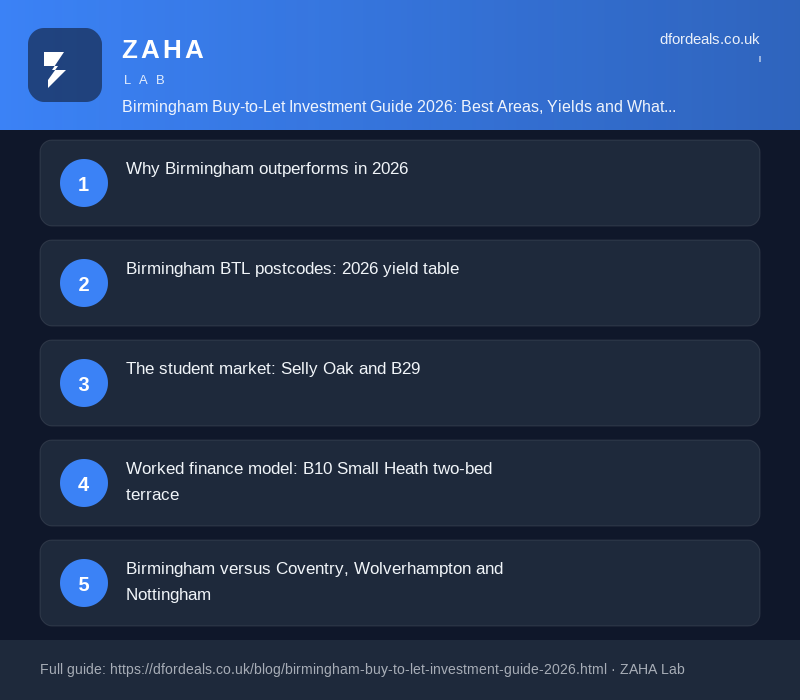
Birmingham's private rental stock fell 13% year-on-year by October 2026, the sharpest landlord-exit rate of any major Midlands city, yet two-bedroom terraces in the city's highest-yield postcodes still start at £135,000, leaving gross yields of 7.5–8.2% intact for investors who move before competition intensifies. Birmingham is one of England's most compelling buy-to-let markets in 2026: it combines gross yields of 6.8–8.2% across its main investment postcodes, a structurally undersupplied rental market, a student population exceeding 92,000, and over 1.5 million employed workers in the City Region, making it one of the most defensible income-and-growth BTL propositions outside London.
Why Birmingham outperforms in 2026
Four structural forces make Birmingham an exceptional BTL market in 2026, each independently significant and compounding together.
Supply is contracting faster than demand is falling. The Renters' Rights Act, the EPC upgrade requirement (all rented properties must meet EPC Band C before new tenancies from 2028), Section 24 mortgage interest restriction and the 5% SDLT surcharge on additional dwellings have accelerated landlord exits nationally. In Birmingham, the effect is more acute: Birmingham City Council's selective licensing scheme, which covers large sections of the inner city, has added compliance cost and complexity that has deterred small landlords from renewing their portfolios. Available rental listings on Rightmove fell 13% year-on-year in October 2026, the steepest drop across all major Midlands cities. With fewer properties available to rent, structural support for rents is in place and voids for well-managed, correctly priced stock are running at under two weeks in most inner Birmingham postcodes.
Rental demand is structurally deep and diversified. Birmingham has five universities with a combined student population exceeding 92,000: the University of Birmingham (~36,000), Birmingham City University (~32,000), Aston University (~16,000), Newman University (~8,000) and University College Birmingham (~6,000). Graduate retention is high: HSBC UK's headquarters at 1 Centenary Square, KPMG's major Birmingham office, Goldman Sachs' Birmingham base and a growing fintech cluster anchor large numbers of graduates in the city rather than exporting them to London. University Hospitals Birmingham NHS Foundation Trust, the largest NHS trust in England, employs over 24,000 staff across the Queen Elizabeth Hospital complex and surrounding sites, creating significant NHS professional tenant demand in B15 and B29. "West Midlands private rents rose 7.8% in the 12 months to August 2026, the second-highest regional increase in England," according to the ONS Private Rental Market Summary Statistics.
The HS2 Curzon Street multiplier is approaching crystallisation. HS2 Phase One, connecting Birmingham Curzon Street to London Euston (journey time approximately 49 minutes when complete), is at an advanced construction stage with the Birmingham terminus site active. Land Registry data shows that postcodes within 1.5 kilometres of Curzon Street, particularly B4, B5 and parts of B7, have recorded above-average price appreciation since 2023 as commercial and residential developers front-run the connectivity premium. The investment case for B-series postcodes immediately surrounding the HS2 zone is now materially different from five years ago.
Entry prices remain viable at current rates. Unlike Manchester's highest-yield postcodes (M40, M19), which have repriced above the stress-test threshold for many investors, Birmingham's inner-city postcodes retain entry-level stock at prices where the gross yield clears 7.5%, a level that sustains modest positive cash flow even at current BTL mortgage rates of 4.5–5.0% interest-only. That window is narrowing as domestic and institutional investor interest in Birmingham intensifies, but it remains open in late 2026.
Birmingham BTL postcodes: 2026 yield table
| Postcode | Area | Gross yield (est.) | Typical 2-bed entry | Avg 2-bed rent/mo |
|---|---|---|---|---|
| B6 | Aston, Lozells | 7.8–8.2% | £135,000–£160,000 | £875–£975 |
| B10 | Small Heath, Bordesley Green | 7.5–8.0% | £140,000–£165,000 | £875–£1,000 |
| B11 | Sparkhill, Tyseley | 7.2–7.8% | £145,000–£175,000 | £900–£1,025 |
| B23 | Erdington, Stockland Green | 6.8–7.4% | £150,000–£185,000 | £875–£1,025 |
| B29 | Selly Oak, Bournbrook | 7.0–7.5% | £175,000–£220,000 | £900–£1,100 |
| B15 | Edgbaston | 5.5–6.2% | £220,000–£300,000 | £1,100–£1,350 |
| B17 | Harborne | 5.2–5.8% | £230,000–£320,000 | £1,000–£1,200 |
Yield estimates are gross (annual rent ÷ purchase price) and assume two-bedroom terraced house or similar. Sources: Land Registry Price Paid Data, Rightmove rental listings, ONS Private Rental Market Summary Statistics Q3 2026. Figures are indicative ranges; individual properties vary.
The student market: Selly Oak and B29
B29 (Selly Oak, Bournbrook) is Birmingham's dominant student BTL postcode, sitting immediately adjacent to the University of Birmingham's Edgbaston campus, approximately one mile from the main arts and science faculties. The University of Birmingham's 36,000-student population generates a large and consistent pool of term-time tenants, with the academic year running September–June creating a predictable letting cycle.
Two-bedroom and three-bedroom terraced houses are the dominant property type in B29, with two-beds achieving £900–£1,100/month and three-bed HMOs (where Article 4 permits) generating £1,350–£1,700/month in total room rents. The B29 HMO market is tightly controlled: Birmingham City Council operates an Article 4 Direction across much of Selly Oak and adjacent Harborne (B17), meaning planning permission is required for C3-to-C4 conversion. Applications are frequently refused where local HMO concentration already exceeds council thresholds. This restriction is a significant barrier to entry, it also protects existing licensed HMO operators from new competition, which is positive for yield stability once a compliant asset is acquired.
For investors unwilling to manage the planning risk in B29, B23 (Erdington) offers comparable gross yields (6.8–7.4%) with a professional tenant demographic, no Article 4 restriction on standard BTL conversion, and a lower management intensity than the student market. B23 is increasingly favoured by portfolio landlords seeking to diversify away from student-dependency in Birmingham.
Worked finance model: B10 Small Heath two-bed terrace
| Acquisition costs | |
|---|---|
| Purchase price (B10 two-bed terrace) | £155,000 |
| Deposit (25%) | £38,750 |
| SDLT (5% additional dwelling surcharge) | £7,750 |
| Mortgage arrangement fee | £1,500 |
| Survey + legal costs | £2,100 |
| Total cash deployed | £50,100 |
| Monthly rent | £950 |
| Annual gross rent | £11,400 |
| Mortgage (75% LTV, 4.75%, interest-only) | −£5,522 |
| Letting management (10%) | −£1,140 |
| Insurance + maintenance allowance | −£1,100 |
| Void allowance (3 weeks) | −£549 |
| Annual net cash flow (pre-tax) | +£3,089 |
Gross yield: 7.4%. Net yield on cash deployed: 6.2%. This model is cash-flow positive before income tax, a meaningful distinction from the Leeds or Manchester equivalents where the finance case at the same rates is thinner. For higher-rate taxpayers owning in personal name, Section 24 restricts mortgage interest relief to the basic rate, reducing the net position. The company (SPV limited company) structure remains the most tax-efficient route for Birmingham BTL at scale; run both personal and SPV tax models with a qualified accountant before proceeding.
"West Midlands private rents rose 7.8% in the 12 months to August 2026, the second-highest regional increase in England," according to the ONS Private Rental Market Summary Statistics. At that rate of annual rent growth, an investor entering B10 in late 2026 at £950/month should, on current trajectory, be achieving £1,025–£1,050/month by late 2027, improving the net yield and cash-flow position further without any re-financing action required.
Birmingham versus Coventry, Wolverhampton and Nottingham
How does Birmingham compare to its nearest competitors in the Midlands BTL investor universe?
- Coventry: Coventry offers strong yields (6.5–8.0% in CV1–CV6) and benefits from the University of Warwick and Coventry University providing 65,000+ students. Coventry's challenge is scale: it is a significantly smaller city than Birmingham, with a less diversified employment base and lower absolute capital growth potential. Birmingham's regeneration pipeline (HS2, Smithfield, Five Ways) is structurally larger than anything planned for Coventry. For pure yield, Coventry is competitive; for yield-plus-growth, Birmingham has the deeper long-term case.
- Wolverhampton: Wolverhampton (WV1–WV3) offers the highest raw yields in the West Midlands, consistently 8–10% gross, at the lowest entry prices in the conurbation (two-bed terraces from £100,000 in some areas). The trade-off is higher management intensity, longer average voids, more complex selective licensing across the city, and a capital growth trajectory that has significantly lagged Birmingham over the five-year period to 2026 (Land Registry HPI). Wolverhampton is a viable satellite strategy for investors already established in Birmingham, not a standalone first port of call for new entrants.
- Nottingham: Nottingham (NG1–NG7) offers yields of 6.5–8.5% with a large dual-university student population (60,000+). Nottingham's specific risk is its citywide selective licensing scheme, currently the largest in England, which applies to virtually all privately rented properties in the city regardless of postcode. Licensing costs and compliance burden are significant and have driven out several institutional landlords. Birmingham's selective licensing is extensive but geographically targeted; Nottingham's is total. Birmingham carries less regulatory risk at portfolio scale.
What to watch out for in Birmingham BTL
Five risks specific to the Birmingham market require active monitoring in 2026:
- Selective licensing complexity and enforcement. Birmingham's selective licensing scheme is one of the most extensive in England and covers large swathes of the highest-yield postcodes (B6, B10, B11, B23). Landlords must obtain a licence for every privately rented property in a designated area, pay the licence fee (typically £500–£800 per property per five years) and meet the scheme's property standards. Failure to licence carries a civil penalty of up to £30,000. Always check licensing status via Birmingham City Council's property licensing portal before exchange.
- EPC upgrade exposure in pre-1930s stock. B6, B10 and B11 contain large volumes of Edwardian and early-interwar terraces that typically sit at EPC Band D or E. External wall insulation or internal lining required to reach Band C (mandatory for new tenancies from 2028) can cost £8,000–£18,000 per property. Factor this into acquisition and hold-cost modelling from day one.
- Article 4 enforcement in Selly Oak and Harborne. Any buyer intending to operate or convert an HMO in B29 or B17 must verify planning status before exchange. Birmingham City Council actively enforces HMO use in breach of Article 4; planning enforcement notices and costly retrospective applications are not uncommon.
- Renters' Rights Act tenancy reform. The Act abolished fixed-term assured shorthold tenancies from September 2026 for new tenancies. All tenancies are now periodic from the outset. Student landlords in B29 must adapt marketing and re-letting cycles accordingly; the academic year no longer provides a natural lease-end date to market re-lets.
- Leasehold apartments in B1/B3/B5. Birmingham city-centre apartment blocks have produced a steady stream of service-charge surprises, cladding remediation levies and ground rent complications. Freehold or share-of-freehold terraced houses in inner-city postcodes carry significantly less leasehold risk than apartments in converted former commercial buildings. If evaluating city-centre stock, obtain three years of service-charge accounts and commission a full structural survey before proceeding.
Birmingham BTL: the investment case in 2026
Birmingham is England's most compelling large-city BTL market outside London in 2026 for investors who run their own numbers. It does not offer Manchester's brand premium or Nottingham's cheapest university-adjacent entry prices. What it offers is the combination of scale, yield, structural demand depth and a regeneration pipeline that is repricing inner-city land values across an extended geography, anchored by HS2, the Smithfield quarter and the ongoing relocation of major employers into Birmingham city centre.
The inner-city postcodes (B6, B10, B11) provide the highest yields and the thinnest competition from domestic equity-rich buyers, the typical purchaser is a cash or leveraged investor, keeping prices close to fundamental rental value. B29 (Selly Oak) provides the most liquid student sub-market, with the University of Birmingham's expansion plans providing a structural demand tailwind through the decade. B23 (Erdington) provides the most defensible asset quality and tenant demographic for investors building a portfolio to hold long-term, with yields that remain above the positive-leverage threshold and capital growth potential linked to Birmingham city's expanding commuter radius.
The finance case at current rates is better in Birmingham than in Manchester or Leeds at equivalent property types, B10's 7.4% gross yield produces a meaningfully positive net cash flow on the worked model above, leaving headroom for rate rises, compliance costs or void periods. "West Midlands private rents rose 7.8% in the 12 months to August 2026," confirming that the rent trajectory is supportive of holding costs at current mortgage rates.
As always, run your own numbers with a qualified mortgage broker and tax adviser before proceeding. The worked model above is illustrative; your specific lender stress test, tax band, property condition, selective licensing status and void assumptions will differ. Birmingham rewards investors who do thorough pre-acquisition due diligence, the compliance environment is demanding, but the yield premium over other English cities reflects that complexity and prices in the operational overhead for investors who manage it well.