Short-Term Let Registration UK 2026: What Airbnb Hosts and SA Operators Must Do Now
An estimated 370,000 properties in England were let as short-term rentals in 2025 — up 73% in five years, according to MHCLG analysis — yet the majority of those operators have still not obtained a registration number under England's new mandatory scheme. The fine for operating without one is up to £2,500 per property per offence, and major platforms including Airbnb are now required to verify registration numbers before accepting new English listings.
England's mandatory short-term let (STL) registration scheme, which became operational in spring 2026, requires every operator who lets a residential property for short periods — individual bookings of up to 90 consecutive nights — to register with their local planning authority, obtain a unique registration number, and display it on all listings. Registration costs £50 per property for a two-year term and is legally separate from any planning permission requirement for a change of use to the new C5 planning use class.
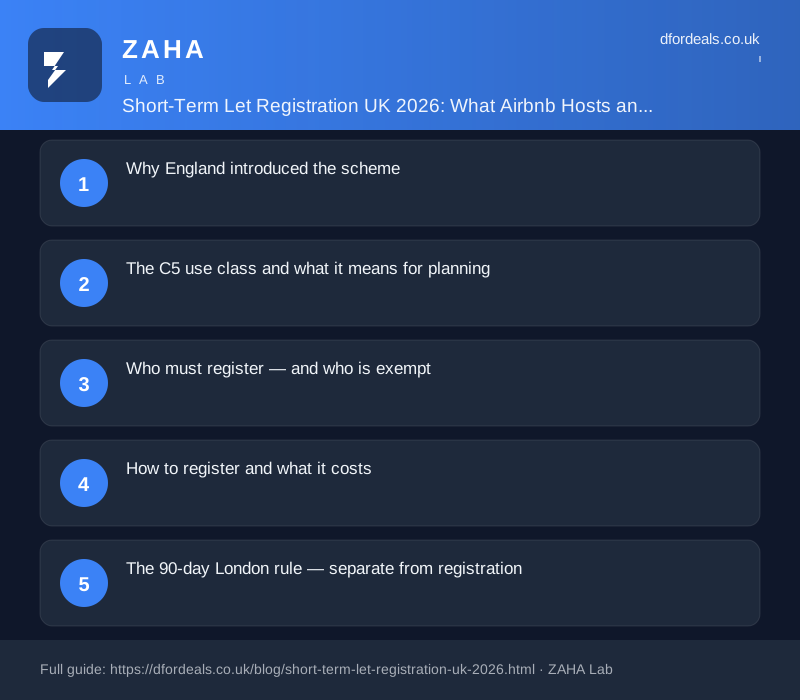
Why England introduced the scheme
The growth of short-term letting through platforms such as Airbnb, Vrbo, and Booking.com accelerated after 2020, when mortgage rate rises made Airbnb-style income more attractive relative to standard assured shorthold tenancies. By 2025, the number of properties advertised as short-term lets in England's coastal towns and National Park gateway communities had materially reduced the stock available for long-term local renters, driving up local rents and generating political pressure in holiday destinations from Cornwall to the Lake District.
The Levelling-up and Regeneration Act 2023 gave the Secretary of State powers to introduce a mandatory register and to create new planning use classes for short-term lets. MHCLG consulted on the scheme in 2023 and 2024 and laid the final regulations before Parliament in late 2025. The register went live for registrations in January 2026, with a six-month grace period for existing operators ending in June 2026. New operators must register before letting.
"An estimated 370,000 properties in England were let as short-term rentals in 2025, a 73% increase over five years, with the highest concentrations in coastal areas, National Parks and inner London boroughs." (MHCLG, Short-Term Let Registration Impact Assessment, 2025)
The C5 use class and what it means for planning
Alongside the registration scheme, MHCLG created Use Class C5 for short-term let properties — dwellings used for commercial short-term letting for more than 90 nights per calendar year where the host is not present. This sits alongside the existing C3 (dwelling house) and C4 (small HMO) use classes.
The critical planning point: a property that was previously occupied as a private home (C3) and is now used as a short-term let for commercial gain on a regular basis represents a material change of use to C5. A material change of use requires planning permission unless permitted development rights apply.
As of October 2026:
- Permitted development rights allow a C3 property to change to C5 use (and back) in most areas of England where the local authority has not removed those rights.
- Councils in high-pressure areas — including many coastal authorities in Cornwall, Devon, and the Lake District, and several London boroughs — have removed permitted development rights via Article 4 directions, meaning a full planning application is required to operate commercially as an STL.
- Operating a property as an STL in an area where permitted development has been removed, without planning permission, is a breach of planning law regardless of whether the property is correctly registered.
Registration and planning permission are legally independent. Obtaining a registration number does not mean you have planning permission, and having planning permission does not replace the obligation to register.
Who must register — and who is exempt
The registration requirement applies to any person who lets a residential property in England on a short-term basis — bookings of up to 90 consecutive nights — through a platform or directly. The key criteria:
| Operator type | Must register? | Notes |
|---|---|---|
| Entire home let, host absent | Yes | Main model for Airbnb-style operators; registration mandatory regardless of nights let |
| Live-in host, spare room let | Yes | Registration required; Rent-a-Room tax relief may still apply (up to £7,500/year tax-free) |
| Serviced accommodation (multiple units) | Yes — each unit | Each individually lettable unit requires its own registration number |
| Holiday let (rural or coastal) | Yes | Also note: Furnished Holiday Let tax regime was abolished April 2025 |
| Long-term let (>90 consecutive nights) | No | Falls outside STL definition; standard AST rules apply |
| Corporate let (>90 nights, one booking) | No | Single booking >90 consecutive nights is not an STL; confirm in the tenancy documentation |
How to register and what it costs
Registration is handled through a national portal administered by MHCLG, with local planning authority data integrated at the back end. The process has six steps:
- Create an account at the national STL register portal (gov.uk). You will need a Government Gateway login or a One Login account.
- Provide property details: full address, council tax reference, number of bedrooms, maximum occupancy, and whether you are the freeholder, leaseholder, or agent.
- Confirm safety compliance: declare that the property holds a valid gas safety certificate (if applicable), a valid EICR (five-year cycle), and working smoke alarms on every floor and a carbon monoxide alarm in rooms with combustion appliances.
- Pay the fee: £50 per property for a two-year registration, payable by card.
- Receive your registration number: typically issued within three working days for complete applications.
- Display the number: the registration number must appear on every listing, advertisement, and direct booking communication for that property.
Registration must be renewed every two years. A change of property address or ownership triggers a new registration requirement; the existing number does not transfer.
The 90-day London rule — separate from registration
Operators in Greater London face a parallel restriction that predates the national registration scheme. The Deregulation Act 2015 allows any residential dwelling in Greater London to be used as a short-term let for up to 90 nights per calendar year without planning permission for a change of use. Exceeding 90 nights in any calendar year without planning consent is a breach of planning law, with fines of up to £20,000.
"London hosts who exceed the 90-night annual threshold without planning permission for change of use face civil penalties of up to £20,000 under Greater London planning enforcement powers." (MHCLG planning enforcement guidance, updated 2026)
Airbnb and other platforms have for several years automatically blocked additional London bookings once a property reaches 90 nights, but this only applies to bookings made through that platform. Operators letting through multiple channels — Airbnb plus Vrbo plus direct bookings — must track cumulative nights across all channels manually. The 90-day cap and the national registration requirement both apply to London properties simultaneously.
England vs Scotland: how the two schemes compare
Scotland introduced mandatory short-term let licensing in October 2022, nearly four years before England's registration scheme. The two frameworks differ in material ways:
| Feature | England (2026) | Scotland (2022) |
|---|---|---|
| Scheme type | Registration (lighter-touch) | Operating licence (full) |
| Administering body | Local planning authority | Local licensing authority |
| Typical cost | £50–£100 | £750–£2,000 |
| Duration | 2 years | 3 years |
| Safety inspections required | Self-declared | Mandatory (council inspection) |
| Public liability insurance required | Recommended, not mandated | Yes — minimum £2 million |
| Night cap | None nationally (London: 90 nights) | None — but control zones can restrict |
| Penalty for non-compliance | Up to £2,500 per breach | Criminal offence, unlimited fine |
| Platform display required | Yes | Yes |
Scotland's licensing regime is more burdensome for operators but provides greater local authority oversight. Scottish councils have issued licence refusals in areas with high housing pressure — most notably in Edinburgh and parts of the Highlands — and a licence refusal effectively removes the right to let commercially. England's registration scheme does not grant the same level of council discretion; registration is confirmatory rather than discretionary in most cases.
Wales short-term let licensing
Wales introduced a mandatory registration and licensing scheme for visitor accommodation under the Tourism (Visitor Accommodation Registration and Licensing) (Wales) Act in 2025. Welsh STL operators must register with Croeso Cymru (Visit Wales) and hold a relevant licence covering fire safety and accessibility standards. Fees and renewal periods are set by Welsh Government regulations and differ from those in England and Scotland. Operators with property across borders must comply with each nation's scheme separately.
Compliance checklist for STL operators in England
- Register the property at the national STL portal before the next booking if you have not already done so. Grace period for existing operators ended June 2026.
- Check the local planning position: confirm whether your local authority has removed permitted development rights for C3-to-C5 change of use via an Article 4 direction. Coastal councils, National Park authorities, and several London boroughs have done so.
- Display your registration number on all listings, booking confirmation emails, and any advertising materials. Failure to display it is a breach even if the property is registered.
- Ensure safety certificates are current: gas safety certificate (annual), EICR (five years), smoke alarms on every floor, CO alarm in rooms with combustion appliances.
- Review your insurance: standard home insurance is typically voided by commercial short-term letting. Specialist STL insurance covering public liability (minimum £1 million recommended), accidental damage, and loss of income is now widely available from providers including Guardhog, Pikl, and Allianz.
- Track booking nights: if letting in Greater London, maintain a cumulative night count across all platforms. Once 90 nights is reached for the calendar year, accepting further bookings without planning permission is a breach.
- Review the FHL tax abolition: the Furnished Holiday Lettings tax regime was abolished from April 2025. If your STL income was previously structured to qualify for FHL treatment (capital allowances, Business Asset Disposal Relief, pension contribution eligibility), revisit your tax position with an accountant. The income is now treated as standard property income for tax purposes.
- Leasehold check: if you own a leasehold flat, check the lease for subletting restrictions. Many standard residential leases prohibit subletting for periods of less than six months or require landlord consent. Operating an Airbnb in breach of a lease covenant risks forfeiture action by the freeholder.
What this means for property investors
For investors evaluating serviced accommodation as a strategy in 2026, the regulatory picture is materially more complex than it was three years ago. The combination of the FHL tax abolition (April 2025), the mandatory registration scheme (January 2026), the C5 use class planning risk, the loss of permitted development rights in many high-demand locations, and increasing Article 4 direction coverage means that STL as a pure yield strategy requires far more due diligence at the acquisition stage than a standard BTL purchase.
The yield potential — average nightly rates of £120–£250 in mid-range leisure markets, with occupancy of 65–75% in well-managed properties — remains materially higher than a standard single-let yield. But the compliance cost, management overhead, and planning risk must be costed in at the outset. A property in a council area that has removed permitted development rights for STL use, held on a leasehold title with subletting restrictions, and previously structured for FHL tax relief is a very different asset in 2026 than it was in 2022.
Before acquiring a property for STL use, verify the planning use class position with a planning consultant, confirm the leasehold position with a solicitor, and speak to a specialist STL accountant about the post-FHL income tax treatment. The registration requirement itself is straightforward and inexpensive — it is the planning and tax layer underneath that determines whether the strategy works.
This article is educational and does not constitute financial, tax, or legal advice. Planning rules, registration requirements, and licensing conditions vary by local authority and are subject to change. Always consult a qualified planning consultant, solicitor, and tax adviser before making decisions about short-term let operations.