Student Property Investment UK 2026: Best University Cities, HMO Rules and What It Really Yields
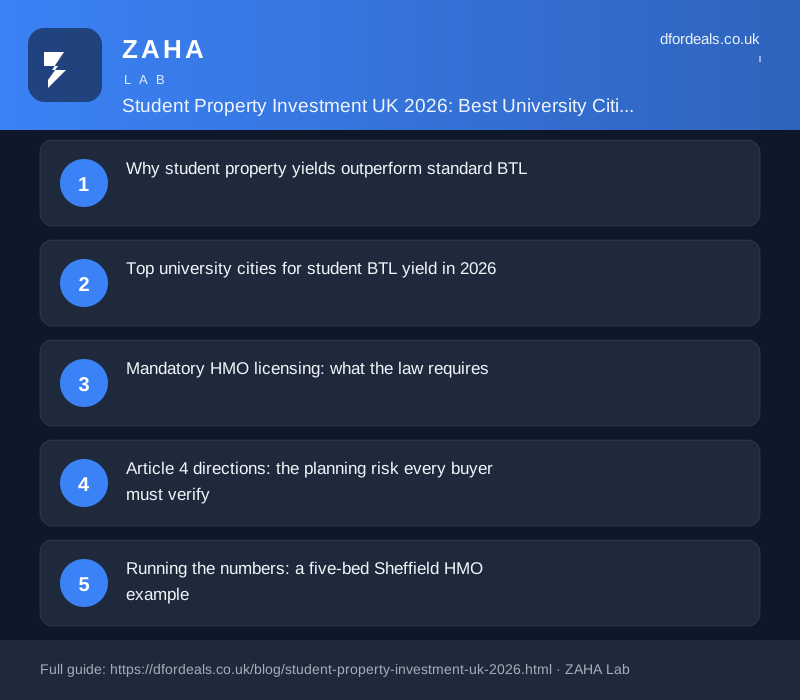
Student HMOs in Sheffield and Newcastle regularly produce gross yields above 8% in 2026 — more than double the sub-4% yields many single-let landlords are accepting in the South East. The catch is that those numbers sit on top of a compliance layer — mandatory HMO licences, Article 4 planning restrictions, fire safety upgrades and annual void periods — that eliminates most of the advantage if you buy without reading the rules first.
Student property investment is the purchase of residential houses in multiple occupation (HMOs) near UK universities, rented room-by-room to full-time students. The model generates higher gross yields than single-let BTL by aggregating multiple rental streams from one property, with demand structured by the academic year rather than ad-hoc market conditions. Entry prices in the best-yielding university cities remain 30–40% below the national average house price of £268,500 recorded by Land Registry in Q3 2026.
Why student property yields outperform standard BTL
The yield advantage is structural, not accidental. A standard five-bedroom house let as a single family home in Leeds might achieve £1,400 per month. The same house configured as an HMO and let room-by-room to students can generate £110–£130 per room per week, or £2,860–£3,380 per month gross when fully occupied. That is a rental uplift of 100–140% from the same asset.
Three factors reinforce the demand side. First, the UK student population has grown consistently over the past decade: HESA data for 2024–25 recorded 2.46 million full-time higher-education students in England alone, with projections pointing to continued modest growth through the decade. Second, purpose-built student accommodation (PBSA) — the managed dormitory blocks developers have been building in city centres — primarily serves first-year students. Second and third-year students typically move into private rented HMOs, sustaining demand for the traditional terraced-house model. Third, the parental guarantor convention in student lettings reduces default risk materially: most student letting agents require parents to co-sign the tenancy agreement and guarantee the rent.
"Average UK house prices in Q3 2026 stand at £268,500 nationally, but in student-intensive postcodes across northern cities, entry prices for three- and four-bedroom mid-terraces that already meet basic HMO standards typically range from £130,000 to £210,000." (Land Registry UK HPI, Q3 2026)
Top university cities for student BTL yield in 2026
The table below shows indicative gross yields for student HMOs across the main English university cities, based on typical room rents achieved in the 2025–26 academic year and prevailing house prices in popular student postcodes. These are market-level estimates; actual performance varies by property, condition, specification and proximity to campus.
| City | Typical entry price (5-bed) | Avg weekly room rent | Indicative gross yield | Article 4 in student areas? |
|---|---|---|---|---|
| Newcastle | £155,000–£175,000 | £105–£120 | 8.4–9.1% | Partial (Jesmond, Heaton) |
| Nottingham | £175,000–£200,000 | £108–£125 | 8.0–8.8% | Yes (city-wide) |
| Sheffield | £170,000–£195,000 | £107–£123 | 7.9–8.6% | Yes (city-wide) |
| Leeds | £195,000–£225,000 | £110–£130 | 7.5–8.3% | Yes (city-wide) |
| Liverpool | £155,000–£185,000 | £100–£118 | 7.6–8.4% | Partial (L17, L15) |
| Birmingham | £210,000–£240,000 | £112–£130 | 6.8–7.5% | Partial (Selly Oak, Edgbaston) |
| Manchester | £225,000–£265,000 | £115–£140 | 6.5–7.3% | Yes (Fallowfield, Rusholme) |
Note: yields are calculated on 44 weeks of rental income (accounting for the summer void) as a proportion of a midpoint purchase price. Use local comparable sold prices and confirmed room-rental evidence before underwriting any specific deal.
Mandatory HMO licensing: what the law requires
The Housing Act 2004 imposes mandatory licensing on any HMO occupied by five or more people forming two or more separate households in England. The 2018 changes removed the previous three-storey condition, so a two-storey house with five students now requires a mandatory licence regardless of height. Operating a licensable HMO without a valid licence is a criminal offence with unlimited fines, and tenants can additionally apply to the First-tier Tribunal for a rent repayment order covering up to 12 months of rent paid during the unlicensed period.
Many university councils extend licensing further through additional licensing schemes. Nottingham, for example, runs a city-wide additional licensing scheme that covers HMOs of three or more occupants. Sheffield operates a similar extended scheme in its student-dense wards. Liverpool introduced a selective licensing scheme covering large parts of the inner city. The practical effect is that three- and four-person student lets which fall below the mandatory threshold often still require a local authority licence.
Typical HMO licence conditions
- Room sizes: minimum floor area of 6.51 m² for a single-occupancy sleeping room under the 2018 national standards (some councils set higher minimums)
- Fire safety: interlinked mains-powered smoke alarms on every floor, heat detector in the kitchen, fire doors with intumescent strips and cold smoke seals to all rooms, emergency lighting on escape routes in larger properties
- Heating: adequate fixed heating in every habitable room
- Kitchen and bathroom: minimum ratios of facilities per occupant set by the council, typically one bathroom per three to four occupants
- Management standards: annual gas safety certificate (CP12), five-yearly electrical installation condition report (EICR), and evidence of appliance PAT testing
Licence applications cost between £400 and £1,200 depending on the council, the number of occupants and whether you are a new or renewing applicant. Licences are valid for five years. Factor the annualised licence cost into your cash-flow model from day one.
Article 4 directions: the planning risk every buyer must verify
An Article 4 direction is a local planning authority decision to remove a permitted development right. In the student property context, many councils have removed the right to change use from a dwelling house (Use Class C3) to a small HMO of up to six people (Use Class C4) without applying for full planning permission. Cities including Leeds, Sheffield, Nottingham, Oxford, Cambridge, and parts of Manchester and Newcastle have implemented Article 4 directions across their student-intensive zones.
This creates two distinct risks for buyers. First, if you purchase a property that has never been formally used as an HMO in an Article 4 area, you cannot simply convert it without planning consent, and consent is not guaranteed. Councils have been increasing refusal rates to manage HMO saturation in areas where the concentration of student houses has eroded the residential community. Second, on exit, an HMO in an Article 4 area can only realistically be sold to another investor intending to continue HMO use — the owner-occupier and standard BTL market is effectively closed — which restricts your buyer pool and can compress the sale price.
"Annual house price growth in Northern England city postcodes remained above the national 2.8% average recorded in September 2026, with the North East posting 4.7% annual growth." (Nationwide HPI, September 2026)
The safest entry strategy in an Article 4 area is to purchase a property that already operates as a licensed HMO with a verifiable track record of HMO use. The previous owner's licence history, planning correspondence and tenancy agreements should be requested and reviewed before exchange. A property operating continuously as an HMO for more than four years may also be eligible for a certificate of lawful use (CLU), which provides the strongest legal confirmation that HMO use is established and lawful regardless of the Article 4 position.
Running the numbers: a five-bed Sheffield HMO example
The following is an illustrative model, not a guarantee of returns. It uses market-level figures for Sheffield in 2026 and standard assumptions for a 75% LTV interest-only buy-to-let mortgage.
| Item | Annual (£) |
|---|---|
| Purchase price (5-bed, Sheffield student area) | £183,000 |
| Gross rental income (5 rooms × £115/wk × 44 wks) | £25,300 |
| Mortgage interest (75% LTV, 4.55% I/O on £137,250) | −£6,245 |
| Management fee (12% of gross) | −£3,036 |
| Buildings insurance | −£600 |
| HMO licence (£900 amortised over 5 years) | −£180 |
| Gas, EICR, compliance certificates | −£450 |
| Maintenance and repairs (est. 8% of gross) | −£2,024 |
| Estimated net annual profit | £12,765 |
| Net yield on deposit (25% = £45,750) | 27.9% |
This model excludes SDLT (the 3% second-home surcharge applies, adding £5,490 on a £183,000 purchase), refurbishment costs to meet HMO standards, and letting agent set-up fees for the first tenancy. The ICR stress test for a portfolio landlord at 145% × 5.5% test rate requires the property to generate at least £8,674 in annual rent to qualify for the mortgage — at £25,300, this property clears that threshold comfortably. Run this test for every property before you offer; the results are not consistent across all configurations and locations.
The five risks that catch student property investors out
- The summer void: Student tenancies typically run September to June or July. Two months of mortgage, insurance, licensing and standing-charge utility costs with zero rent income can cost £1,500–£2,000 depending on the mortgage balance and running costs. Build a specific void reserve rather than treating it as an emergency.
- HMO licensing non-compliance: Councils have stepped up enforcement. Civil penalties of up to £30,000 per breach are now routinely issued for fire safety failures, unlicensed operation and management standard breaches. Tenants can pursue a rent repayment order at tribunal covering every month rent was paid during non-compliance. The reputational and financial exposure is asymmetric.
- Article 4 exit restriction: Properties in Article 4 areas sell to a narrower buyer pool. Factor this into your hold period planning and do not assume you can sell to a first-time buyer if you need to exit.
- PBSA competition: Purpose-built student accommodation blocks continue expanding in Leeds, Manchester, Sheffield and Birmingham. They primarily attract first-year and international students, but in oversupplied PBSA markets some operators have begun targeting second and third years with competitive pricing and amenity packages. Monitor local PBSA pipeline before committing to a city.
- Creeping Article 4 expansion: A council that has not yet implemented an Article 4 direction across your target ward can do so at any time with as little as two weeks' notice in exceptional circumstances (though four to eight weeks is typical for non-emergency directions). If conversion is your plan, execute it before new directions come into force.
Finance: HMO mortgages in 2026
Mainstream lenders largely avoid HMO buy-to-let. Products are available through specialist BTL lenders and broker-only ranges from providers including Precise Mortgages, Foundation Home Loans, Shawbrook Bank, Aldermore, and Paragon. For properties of up to six bedrooms, five-year fixed interest-only rates in October 2026 typically start around 4.5% to 4.7% at 75% LTV for qualifying applications. Above seven bedrooms, valuers often apply a commercial rather than residential methodology, which can affect both the valuation and the lending terms.
Most HMO lenders require the property to hold a valid HMO licence at the time of drawdown. If you are buying a property that needs converting, you will either need to complete the conversion and obtain the licence before exchange, or use a bridging loan to fund the conversion period before refinancing onto a term HMO mortgage once the licence is in place. Bridging rates in 2026 run at approximately 0.65–0.95% per month; factor the interest cost into your refurbishment budget.
What to check before you buy
- Confirm whether an Article 4 direction covers the specific postcode via the local authority planning portal
- Request a copy of the current HMO licence, conditions attached, and any previous enforcement correspondence
- Obtain a copy of the most recent EICR and gas safety certificate
- Check room sizes against the national minimum standards and the local authority's own additional conditions (some councils require larger minimums than the national 6.51 m²)
- Verify that the property is in the correct council tax band and that the landlord, not the tenants, is registered as liable (standard for all-inclusive student lets)
- Run the ICR stress test at 145% × 5.5% and confirm the projected rent meets the threshold with your target lender before committing to an offer
- Speak to a local specialist student letting agent to confirm current room rents and void rates in the specific street or area — yields in tables like the one above are area averages, not street-level guarantees
Student property investing rewards research and compliance. The yield premium over standard BTL is real and durable, but the licensing complexity and planning constraints are equally real and consistently trip up investors who treat student HMOs as a straightforward BTL purchase. Treat the compliance layer as the cost of entry and price it in from the beginning.
This article is educational and does not constitute financial or investment advice. Always consult a qualified mortgage broker, solicitor and tax adviser before making an investment decision.