Empty Property Council Tax Premiums Explained: What UK Investors Pay in 2026
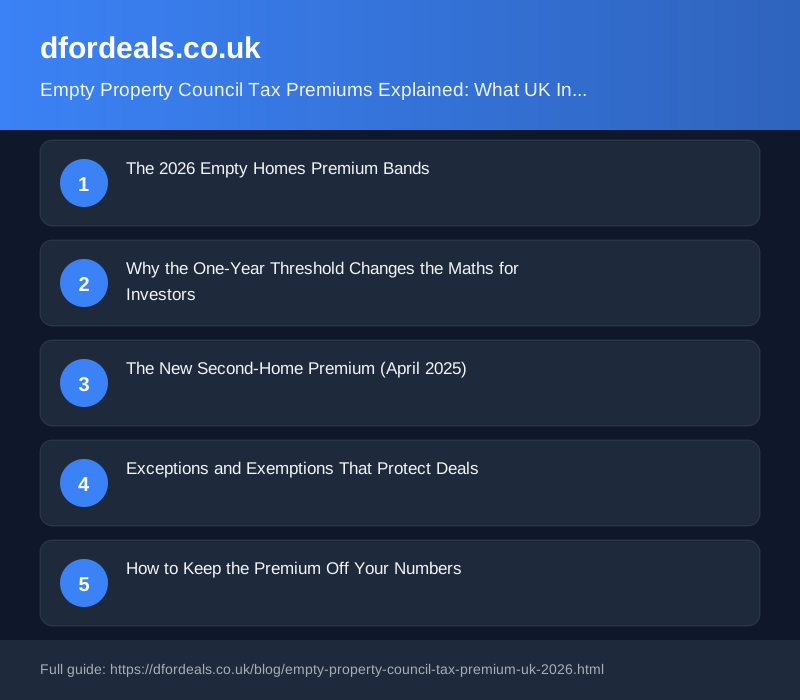 data-pin-media="https://dfordeals.co.uk/blog/images/empty-property-council-tax-premium-uk-2026.png" data-pin-description="Empty Property Council Tax Premiums Explained: What UK Investors Pay in 2026" data-pin-url="https://dfordeals.co.uk/blog/empty-property-council-tax-premium-uk-2026.html"
The council tax bill on an empty property is now one of the fastest-growing costs in any refurbishment or flip — and it starts biting after just twelve months. Since April 2024, an English home left empty and unfurnished can attract a 100% premium after one year, not the two years investors were used to. For anyone running a BRRR project, a probate purchase or a long refurbishment, a void that drifts past its first birthday now quietly doubles the council tax and keeps climbing. Here is exactly how the 2026 premium bands work, the second-home rules that landed this year, the exceptions that matter, and how to keep the charge off your deal.
An empty property council tax premium is an extra charge — on top of the standard 100% council tax bill — that local authorities can levy on homes that stay empty and substantially unfurnished for a set period. It exists to push long-term empty homes back into use, and the longer a property sits empty, the higher the premium climbs.
The 2026 Empty Homes Premium Bands
The premium is set out in the Local Government Finance Act 1992, as amended by the Levelling-up and Regeneration Act 2023. It rises in steps according to how long the property has been continuously empty. In England the maximum rates a council can charge are:
| Time empty & unfurnished | Maximum premium | Total council tax payable |
| Under 1 year | 0% | 100% (standard bill) |
| 1 to 5 years | Up to 100% | Up to 200% (double) |
| 5 to 10 years | Up to 200% | Up to 300% (triple) |
| 10 years or more | Up to 300% | Up to 400% (quadruple) |
So a Band C property with a £2,000 standard annual bill becomes £4,000 once it passes the one-year mark, £6,000 after five years, and £8,000 after a decade — assuming your council applies the full premium. Put simply: leave a house empty long enough and the state charges you four times the council tax for the privilege.
Key data point: From 1 April 2024, the Levelling-up and Regeneration Act 2023 reduced the point at which the long-term empty homes premium can apply from two years to one year, and from 1 April 2025 gave English councils the power to charge a premium of up to 100% on furnished second homes, according to gov.uk council tax guidance. The vast majority of billing authorities adopted both measures at the earliest opportunity.
Why the One-Year Threshold Changes the Maths for Investors
Under the old two-year rule, most refurbishment projects finished, sold or let long before any premium applied. A twelve-month clock is a very different thing. A probate purchase that takes months to complete, a heavy refurbishment that overruns, a planning dispute, or simply a property that won't sell in a soft market can all push a void past a year — and the day it does, the council tax doubles.
The clock also does not reset when a property changes hands. If you buy a house that has already been empty for eight months, you inherit that history: the premium can kick in just four months into your ownership. This catches out buyers of long-empty stock at auction, where cheap "problem" properties are exactly the ones most likely to be carrying an empty-homes record.
The New Second-Home Premium (April 2025)
Separately from empty homes, English councils gained the power from 1 April 2025 to charge a premium of up to 100% on furnished second homes — technically, dwellings that are "no one's sole or main residence" but are substantially furnished. This is aimed at holiday homes and pieds-a-terre, and it doubles the council tax even though the property is not empty at all.
It matters most for serviced accommodation and holiday-let investors. A short-term let that is genuinely run as a business and meets the letting-availability tests can move onto business rates instead of council tax; one that does not can be caught by the second-home premium. The devolved picture is tougher still: Wales permits premiums of up to 300% on second homes and long-term empties, and Scotland allows up to 100% on second homes — so location is everything.
Exceptions and Exemptions That Protect Deals
The premium is not inescapable. Government regulations set out national exceptions, and a genuine investment project usually fits one of them if the timeline is managed. The key ones:
- Actively marketed for sale or let — a 12-month exception applies while a property is genuinely on the market, giving you a window to sell or rent before the premium lands.
- Undergoing major repairs or structural alteration — properties being actively worked on to make them habitable can get a separate exception of up to 12 months, which is the one most refurb investors rely on.
- Recently inherited (probate) — a property left empty following the owner's death is exempt while probate or letters of administration are obtained, and for up to six months afterwards.
- Annexes and job-related dwellings — annexes used as part of a main home, and homes kept empty for work reasons, are excepted from the relevant premium.
Two things to remember: exceptions are time-limited and evidence-led, so keep dated photos, contractor invoices and marketing listings; and a property that is merely empty because you haven't got round to it does not qualify. The exceptions reward genuine activity, not inactivity.
Watch the "furnished" line: the long-term empty premium only applies to homes that are empty and substantially unfurnished. Some investors leave a property lightly furnished to sidestep the empty-homes premium — but that can instead expose it to the new second-home premium if it is nobody's main residence. There is no clever furnishing trick that dodges both; the reliable answer is to get the property occupied or sold.
How to Keep the Premium Off Your Numbers
For deal-focused investors, the premium is a project-management problem more than a tax problem. The levers that actually work:
- Underwrite the void from day one. When you analyse a deal, price in council tax for the full expected void — and stress-test what a 100% premium does to the numbers if the project slips past twelve months.
- Check the property's empty history before you buy. Ask the seller and the council how long it has been empty. On auction stock, assume the worst and confirm whether a premium is already running.
- Refurbish on a tight critical path. The single biggest saving is finishing the works and getting a tenant or buyer in before the one-year mark. A disciplined BRRR timeline usually clears the property long before any premium applies.
- Claim the right exception, with evidence. If a heavy refurbishment will genuinely run long, apply for the major-repairs exception and document every stage. Don't assume the council will grant it automatically.
- Talk to the billing authority early. Empty-homes and premium policies are set locally and vary widely. A five-minute call to the council tax team is cheaper than a surprise doubled bill.
The Bigger Picture for 2026
The direction of travel is clear: empty and under-used homes are being taxed harder every year, and the thresholds are getting shorter, not longer. For the market that is arguably healthy — it pushes neglected stock towards refurbishment and back into use, which is exactly the kind of deal a sourcing-led investor wants to find. But it turns slow projects into expensive ones. In 2026, the investors who win with empty and problem properties are the ones who move fast, keep voids short, and treat the twelve-month clock as a hard deadline rather than a distant worry.
Frequently Asked Questions
How much extra council tax do you pay on an empty property in 2026?
English councils can charge up to a 100% premium once a home has been empty and unfurnished for one year, so you pay double the standard bill. It rises to up to 200% after five years (triple) and up to 300% after ten years (quadruple). Because the premium is discretionary, the exact rate depends on your local authority.
When did the one-year empty property premium start?
From 1 April 2024. The Levelling-up and Regeneration Act 2023 let English councils apply the long-term empty homes premium after one year instead of two. Most adopted the shorter threshold, so a home empty since early 2025 can already carry a 100% premium in 2026.
Is there a council tax premium on second homes?
Yes. From 1 April 2025, English councils can charge up to 100% on furnished second homes that are no one's main residence. Wales allows up to 300% and Scotland up to 100%, so holiday-let and pied-a-terre investors should check the local policy before buying.
Can property investors avoid the empty homes premium?
You can't opt out, but exceptions exist — a 12-month exception for properties being actively marketed for sale or let, and a separate 12-month exception for homes undergoing major repairs. The most reliable route is to keep void periods short: refurbish quickly, let or sell within a year, and document the works.