How to Buy Property Below Market Value in 2026: UK Investor Guide
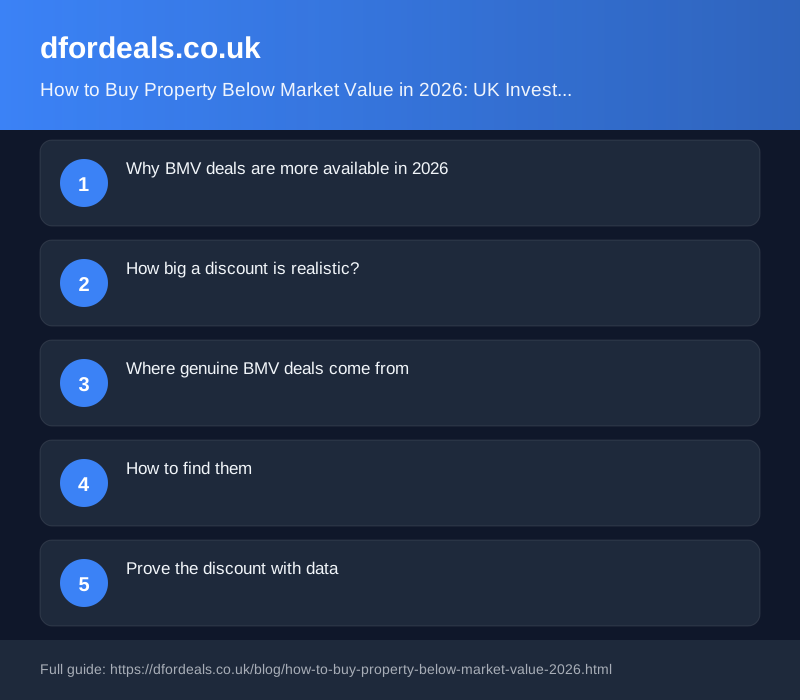 data-pin-media="https://dfordeals.co.uk/blog/images/how-to-buy-property-below-market-value-2026.png" data-pin-description="How to Buy Property Below Market Value in 2026: UK Investor Guide" data-pin-url="https://dfordeals.co.uk/blog/how-to-buy-property-below-market-value-2026.html"
Buying below market value is the closest thing property investing has to a free lunch — but only if the discount is real. In a cooler 2026 market, where headline prices are drifting lower and homes are sitting on the market longer, genuine below-market-value (BMV) opportunities are more common than they were during the frenzied years. The catch is that most "BMV" deals advertised to investors are nothing of the sort: they are discounts against an inflated asking price, not against what a property would truly fetch. This guide sets out how to find real BMV deals, how to prove the discount with hard data, and how to finance a purchase fast enough to secure it.
What is a below-market-value property? A below-market-value property is one bought for less than its true open-market value — the price it would realistically achieve with normal marketing. For UK investors, BMV usually means a genuine discount of 10% or more against verified sold-price comparables, secured through a motivated seller, speed, or a problem other buyers avoid.
Why BMV deals are more available in 2026
The market backdrop matters. When prices are rising and buyers are queuing, sellers have no reason to accept a discount. When the market softens, the balance of power shifts — and that is exactly what has happened this year. Nationwide's House Price Index put the average UK home at around £263,500 in June 2026, with prices down 0.2% on the month and annual growth slowing to just 1.1% — the weakest pace in more than two years.
That cooling does three things for a disciplined buyer. Stock has risen, so sellers compete for fewer committed buyers. Properties are taking longer to sell, which turns "want to move" into "need to move". And with the Bank of England holding Bank Rate at 3.75%, some over-leveraged owners are motivated to exit before their next remortgage. Softer markets do not create distress on their own, but they widen the gap between asking prices and achieved prices — and that gap is where BMV lives.
How big a discount is realistic?
Be honest about what "below market value" means in practice. A 40% discount is the stuff of seminars, not solicitors' completions. Here is a realistic scale for 2026:
| Discount to true value | What it signals | How common |
|---|---|---|
| 5–10% | Keen seller or minor issues; normal negotiation | Frequent |
| 10–15% | A solid BMV deal worth pursuing | Achievable with effort |
| 15–25% | Strong deal — usually speed, condition or legal complexity | Uncommon |
| 25%+ | Exceptional; often auction, probate or serious problems | Rare |
The number that matters is the discount to true value, not to the asking price. An agent can put any figure on a listing; only sold comparables tell you what the market actually pays.
Where genuine BMV deals come from
Real discounts almost always trace back to a seller who values speed and certainty over squeezing out the last few thousand pounds. The most reliable sources are:
- Probate and inherited property — beneficiaries often want a clean, fast sale to release funds and avoid the cost of maintaining an empty home.
- Repossessions and distressed sales — lenders and receivers prioritise a quick, certain completion over the last 5%.
- Landlords exiting the market — tax changes, EPC rules and regulation are prompting sales, sometimes with sitting tenants that deter mainstream buyers.
- Divorce, relocation and emigration — a firm deadline makes speed worth a discount.
- Refurbishment projects — properties needing work that mortgage lenders won't touch, cutting out most competing buyers.
- Auctions — the definitive fast, certain sale; see our UK property auction guide for how to buy safely under the hammer.
How to find them
BMV deals are found, not stumbled upon. The investors who buy well run a repeatable sourcing process rather than refreshing the portals and hoping:
- Filter the portals for motivated signals — "price reduced", "chain-free", "cash buyers only", "in need of modernisation", and listings that have been live for 12 weeks or more.
- Build agent relationships — the best deals are placed with buyers agents already know can complete quickly, before they ever hit Rightmove.
- Go direct to vendor — targeted letters to owners of empty or probate properties can reach sellers who haven't yet listed.
- Watch the auction catalogues — both the room and online, including lots that failed to sell and can be bought post-auction.
- Use deal packagers carefully — sourcers can save time, but verify every "BMV" claim yourself; the discount is only as good as the comparables behind it.
For a wider view of sourcing tactics, our top deal sourcing strategies breakdown covers each channel in more depth.
Prove the discount with data
This is the step amateurs skip and professionals never do. Before you get excited about any "20% below market value" pitch, establish the true value independently:
- HM Land Registry sold prices are the definitive record of what buyers actually paid for comparable homes on the same street or estate — the free Price Paid Data is the single most valuable tool an investor has.
- The ONS House Price Index, which is built on Land Registry completions, sets the regional trend so you can adjust older comparables for market movement.
- Nationwide and Halifax indices give an early read on where agreed prices are heading this month.
The rule is simple: anchor your valuation to sold comparables, adjust for condition and market movement, then measure your discount against that figure. If the deal only looks like BMV against the asking price, it isn't a deal.
Financing a BMV purchase
The reason discounts exist is that sellers are buying speed and certainty from you. That means your finance has to move fast, which rules out the slow, ordinary mortgage route for many deals. The common approaches:
- Cash — the strongest position; you complete in days and negotiate the deepest discounts.
- Bridging finance — short-term lending that funds a fast purchase (and often refurbishment), repaid when you refinance or sell. It's expensive, so the exit must be watertight.
- BRRR — buy, refurbish, refinance, rent. You purchase below value with short-term finance, add value through works, then refinance onto a buy-to-let mortgage against the higher valuation to pull your capital back out.
Whichever route you choose, model the full cost — finance, refurbishment, voids and stamp duty — before you commit. A 15% discount that is swallowed by bridging interest and an over-running refurb is no discount at all. Run every purchase through a proper deal analysis and pressure-test it with our deal analyser and BRRR calculator first.
The risks to respect
A discount is compensation for risk, and it pays to know what you are being paid for. The common traps:
- The "discount" is fictional — measured against a puffed-up asking price rather than real value.
- Hidden condition problems — subsidence, damp, non-standard construction or short leases that explain the low price and cost more than the saving.
- Finance falls through — heavily discounted purchases can trigger lender caution and down-valuations; line up finance before you offer.
- Legal complexity — sitting tenants, restrictive covenants or unregistered title can delay or derail completion. Use a conveyancer who knows investor deals.
Key takeaways
- The 2026 market favours buyers. Softer prices, more stock and longer listings have widened the gap between asking and achieved prices where BMV deals live.
- Measure against sold prices, not asking prices. Land Registry Price Paid Data is your anchor; anything else is marketing.
- Real discounts come from motivated sellers — probate, repossessions, exiting landlords, auctions — who value speed over top price.
- Speed unlocks the discount. Cash, bridging or BRRR let you complete fast; slow finance loses the deal.
- Cost the whole deal. After finance, refurbishment and stamp duty, a paper discount can vanish — stress-test before you commit.
Buying below market value is a skill, not a stroke of luck — it comes down to sourcing consistently, valuing rigorously and completing reliably. If you want to build those skills systematically, the Progressive Property training system covers deal sourcing, negotiation and BMV strategy for UK investors at every level. And before you make any offer, run the numbers: our deal analyser is the fastest way to know whether a "discount" is worth pursuing.