Inheritance Tax and Property UK 2026: What Landlords with BTL Portfolios Must Plan For Now
A retired landlord in Yorkshire with a five-property BTL portfolio worth £950,000 died in 2025 with no IHT planning in place. Her estate faced a £220,000 tax bill — payable within six months — that forced a fire sale of two properties to raise the cash. Her family received significantly less than the portfolio was worth because neither she nor her solicitor had reviewed the numbers against frozen nil-rate band thresholds.
Inheritance tax (IHT) is the 40% tax levied on the portion of a UK estate above the available nil-rate band thresholds, currently £325,000 per individual (frozen until at least 2030). Buy-to-let property receives no Business Property Relief exemption, meaning a landlord's rental portfolio counts at full market value in the estate. With UK house prices averaging £290,000 nationally according to ONS data for August 2026, even a modest two-property portfolio can breach the individual nil-rate band with room to spare.
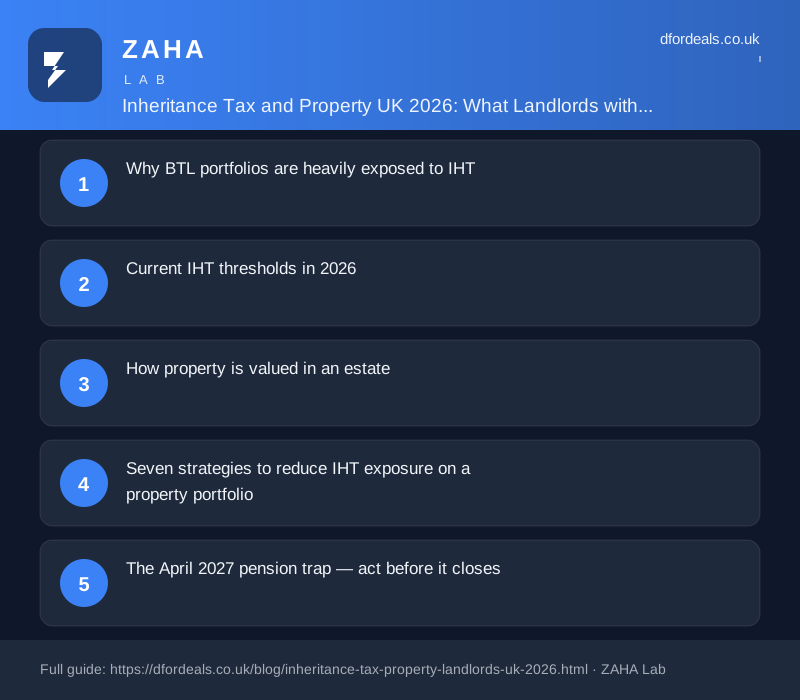
Why BTL portfolios are heavily exposed to IHT
Three factors combine to make buy-to-let property one of the most IHT-vulnerable asset classes in the UK.
No Business Property Relief. BPR allows qualifying business assets to be passed on free of IHT at either 50% or 100% relief. Trading businesses, shares in qualifying unlisted companies, and certain AIM-listed stocks can qualify. Residential rental property does not. HMRC's position — consistently upheld in tribunal cases — is that collecting rent from tenants is an investment activity, not a trading business. A landlord with 20 properties, a full-time property manager, and complex operations still cannot claim BPR on the portfolio.
Frozen thresholds and rising values. The nil-rate band has been frozen at £325,000 since 2009 and will remain frozen until at least 2030 under current government projections. UK average house prices have risen approximately 68% since 2009 in nominal terms, according to ONS House Price Index data. The result is that thresholds have fallen significantly in real terms while property values have grown, pulling millions of households into IHT exposure who were never intended to pay the tax.
Illiquid asset class, liquid tax bill. IHT must be paid to HMRC within six months of death, or interest accrues. Property cannot be sold quickly at full value without risk of a depressed sale. The mismatch between an illiquid asset and a six-month payment deadline is the practical problem that most landlord estates face.
"According to HMRC's Inheritance Tax Statistics for 2023-24, IHT receipts totalled £7.5 billion — a record high — with 4.4% of all UK deaths resulting in an IHT liability, up from 3.7% in 2019-20. HMRC projects this proportion will continue rising as frozen thresholds interact with house price growth, reaching approximately 1 in 14 deaths by 2027-28." (Source: HMRC Inheritance Tax Statistics, 2023-24)
Current IHT thresholds in 2026
Understanding the available thresholds is the starting point for any IHT planning exercise.
| Allowance | Amount (2026) | Condition | Transferable to spouse? |
|---|---|---|---|
| Nil-rate band (NRB) | £325,000 | Per individual, no conditions | Yes, unused portion transfers |
| Residence nil-rate band (RNRB) | £175,000 | Main home must pass to direct descendants | Yes, unused portion transfers |
| Combined (married couple, both allowances) | Up to £1,000,000 | Both NRBs + both RNRBs on second death | Requires formal transfer claim |
| RNRB taper threshold | Above £2,000,000 | RNRB reduces by £1 per £2 over £2m | Applies to each individual estate |
For a single individual with no qualifying main residence or direct descendants, only the £325,000 NRB is available. A landlord with a portfolio valued at £600,000, net of mortgages, would face an IHT liability of approximately £110,000 at 40% on the £275,000 excess above the NRB. This is a realistic scenario for many mid-sized BTL investors.
How property is valued in an estate
For IHT purposes, property is valued at its open market value on the date of death — the price a willing buyer would pay to a willing seller in the market. This is typically determined by a RICS surveyor's valuation or by reference to comparable sales. If the property carries a mortgage, only the net equity (market value minus outstanding mortgage) forms part of the estate. An interest-only BTL mortgage does not reduce the IHT liability on a £200,000 property if the property has been fully paid off.
Properties held through a limited company (SPV) are valued differently. The shares in the company form part of the estate, and the shares are valued based on the underlying net asset value — broadly the same economic outcome as personal ownership for IHT purposes, though the mechanics of valuation and transfer differ. If the shares represent a minority holding, a discount for lack of control and marketability may be applied by HMRC negotiation.
Seven strategies to reduce IHT exposure on a property portfolio
1. Gifting under the seven-year rule
Gifts made outright to individuals more than seven years before death are completely exempt from IHT (potentially exempt transfers, or PETs). Gifts made in the final three years before death are taxed at the full 40% rate. Between three and seven years, taper relief reduces the rate: 32% at 3–4 years, 24% at 4–5 years, 16% at 5–6 years, 8% at 6–7 years, 0% beyond seven years.
The critical caveat is the gift-with-reservation rule. If you give a property to your children but continue to receive the rental income, the gift has not legally left your estate — HMRC treats it as still belonging to you. For a property gift to be effective for IHT purposes, the donor must give up all economic benefit from it.
Gifting also triggers a Capital Gains Tax disposal at the time of transfer. The market value at the date of gift becomes the disposal value, regardless of what was actually paid. If the property has appreciated significantly, the CGT exposure must be modelled against the IHT saving before proceeding. Holdover relief may defer the gain for gifts into certain qualifying trusts.
2. Annual gifting allowances
Each individual can give away up to £3,000 per year free of IHT (the annual exemption). Unused allowance from the previous year can be carried forward for one year, giving a maximum of £6,000 per person in the first year of making gifts. While this does not directly transfer property, accumulated cash gifts over years can be used by beneficiaries to service deposits or purchase property assets outside the donor's estate.
3. Discretionary trusts
A discretionary trust moves assets out of the estate while allowing flexibility over who benefits and when. Assets placed in trust are immediately outside the estate for IHT purposes after seven years from the date of transfer (the transfer itself is a chargeable lifetime transfer, subject to 20% IHT if above the NRB at the time). Trusts are subject to a periodic charge every 10 years (up to 6% of the trust value above the NRB) and an exit charge when assets leave the trust.
Discretionary trusts are complex and carry administration costs including annual trust tax returns and trustee obligations. They are most effective where the estate significantly exceeds the available thresholds and where the settlor genuinely intends to give up control of the asset.
4. Life insurance written in trust
A whole-of-life or term insurance policy written in trust pays the death benefit directly to the named beneficiaries outside the estate, without passing through the estate for IHT. The policy proceeds can be used to pay the IHT bill, preventing forced property sales. Crucially, the policy itself must be written in trust at inception — policies held personally form part of the estate. The premium payments do not reduce the estate for IHT purposes, but the death benefit is fully exempt.
For many landlords with large portfolios, a whole-of-life policy written in trust, sized to cover the estimated IHT liability, is the most cost-effective and practical IHT mitigation tool — particularly for investors who do not wish to restructure their portfolio.
5. Spousal exemption and equalisation
Assets transferred between UK-domiciled spouses are fully exempt from IHT both during life and on death. On the first death, assets passing to the surviving spouse do not use up the NRB — the unused NRB is instead transferred to the surviving spouse's estate for use on the second death. For couples where one spouse owns most of the portfolio personally, equalising the portfolio between spouses (so each uses their own NRB) can reduce the overall IHT bill significantly, though this may trigger a CGT disposal.
6. Pension maximisation
Until April 2027, pension funds remain outside the estate for IHT purposes. This makes pension contributions one of the most tax-efficient uses of surplus rental income for landlords with available earnings or profit from an SPV structure. From April 2027, this changes: inherited pension funds will count in the estate for IHT calculations. Landlords using a pension as the primary IHT mitigation vehicle should model the impact of this change urgently and review their strategy before the 2027 implementation date.
7. Charitable giving
Leaving 10% or more of the net estate to a qualifying charity reduces the IHT rate on the remainder from 40% to 36%. For estates where charitable giving aligns with the individual's objectives, this can represent a meaningful saving while also benefiting causes the donor values. The calculation is applied to the taxable portion of the estate after deducting the available nil-rate bands.
"According to ONS House Price Index data for August 2026, the average UK house price stands at £292,000 — up from £174,000 in January 2009 when the nil-rate band was last increased. The nil-rate band has therefore effectively halved in real purchasing power terms over this period, ensuring that any landlord who has held property since before 2012 is likely to face significant IHT exposure without active planning." (Source: ONS UK House Price Index, August 2026)
The April 2027 pension trap — act before it closes
The single most urgent change on the horizon for property investors is the pension IHT change scheduled for April 2027. Under current rules, defined contribution pension pots sit outside the estate entirely — a landlord with £300,000 in a SIPP and a £700,000 property portfolio has a total estate of £1,000,000 for lifestyle purposes but only £700,000 for IHT purposes, saving potentially £120,000 in IHT.
From April 2027, the pension fund value will count in the estate. The same investor's IHT calculation will include the full £1,000,000, potentially doubling their IHT exposure depending on their available allowances. The 2024 Labour Budget announcement of this change has already prompted many financial planners to recommend spending down pension pots before 2027 or restructuring the estate to maximise other exemptions before the window closes.
Property investors who have relied on a pension as their IHT buffer must review their position with a qualified financial adviser before the change comes into force.
When to get professional advice — and who to use
IHT planning for property portfolios sits at the intersection of property law, trust law, tax law, and financial planning. No single generalist adviser covers all of these competently. The recommended approach is:
- Initial estate review: A chartered tax adviser (CTA) or accountant specialising in property can model your current IHT exposure and identify the most material levers. Expect to pay £500–£1,500 for a thorough review of a three-to-five property portfolio.
- Trust or gifting strategy: A solicitor qualified to STEP (Society of Trust and Estate Practitioners) standard for drafting. STEP membership indicates specialist training in trusts and succession planning rather than general conveyancing.
- Life insurance in trust: A whole-of-life policy written in trust must be structured by a qualified independent financial adviser (IFA), not by a general insurance broker. The policy structure and trust wording both need to be correct for the policy to remain outside the estate.
- Pension restructuring: A pension specialist or IFA regulated by the FCA for pension advice. This is a regulated activity and must not be undertaken without FCA authorisation.
The cost of professional advice is typically 0.3–0.8% of the estate value for a comprehensive strategy. For a £700,000 BTL portfolio facing a £150,000 IHT liability, spending £3,500–£6,000 on planning that eliminates or materially reduces that liability is straightforward arithmetic.
Action checklist for UK landlords in 2026
- Calculate your current estate value: add all property net equity, cash, investments, and pension pots (note: pensions exempt until April 2027)
- Subtract your available NRB (£325,000) and RNRB if applicable (£175,000 if passing main home to direct descendants)
- If the excess is above £100,000, commission a formal IHT planning review this year
- If you hold a pension with a significant balance, model the post-April 2027 position now and discuss drawdown or alternative strategies with a pension specialist before the change takes effect
- Review whether any property is held personally where equity could be equalised with a spouse to maximise both nil-rate bands on the second death
- Obtain a whole-of-life quotation written in trust to cover the estimated IHT liability as an insurance fallback — this does not require restructuring the portfolio
- If gifting is under consideration, model the combined CGT and IHT position before making any transfers
- Ensure all Wills are current, reflect the current portfolio structure, and make use of available allowances — a Will written before the portfolio was built may not reflect the estate's current complexity
Inheritance tax on a property portfolio is not inevitable. It is, however, the default outcome for landlords who do not plan. The strategies available in 2026 — gifting, life insurance in trust, spousal equalisation, trust structures, and pension maximisation before the 2027 rule change — are well-established, legal, and effective. The constraint is not a lack of tools. It is the absence of a professional review that sets out the numbers clearly enough to act on them.