Renters Rights Act 2026: Timetable for Next Phases Revealed
 data-pin-media="https://dfordeals.co.uk/blog/images/renters-rights-act-phases-timetable-2026.png" data-pin-description="Renters Rights Act 2026: Timetable for Next Phases Revealed" data-pin-url="https://dfordeals.co.uk/blog/renters-rights-act-phases-timetable-2026.html"
The Ministry of Housing, Communities and Local Government (MHCLG) has confirmed the broad timetable for the next phases of the Renters Rights Act, with a Private Rented Sector Database, a new independent landlord ombudsman and an extension of Awaab's Law to private tenancies all scheduled to begin rolling out from late 2026. For landlords and property investors, these changes represent the most significant regulatory overhaul in a generation — and the clock is already ticking.
The substance of the Act came into force on 1 May 2026, abolishing Section 21 no-fault evictions and introducing periodic tenancies as the default. Now the government has published what comes next, and the detail matters for anyone letting property in England. Below is our breakdown of each phase, what it means for landlords, and the practical steps you can take now to get ahead of the compliance curve.
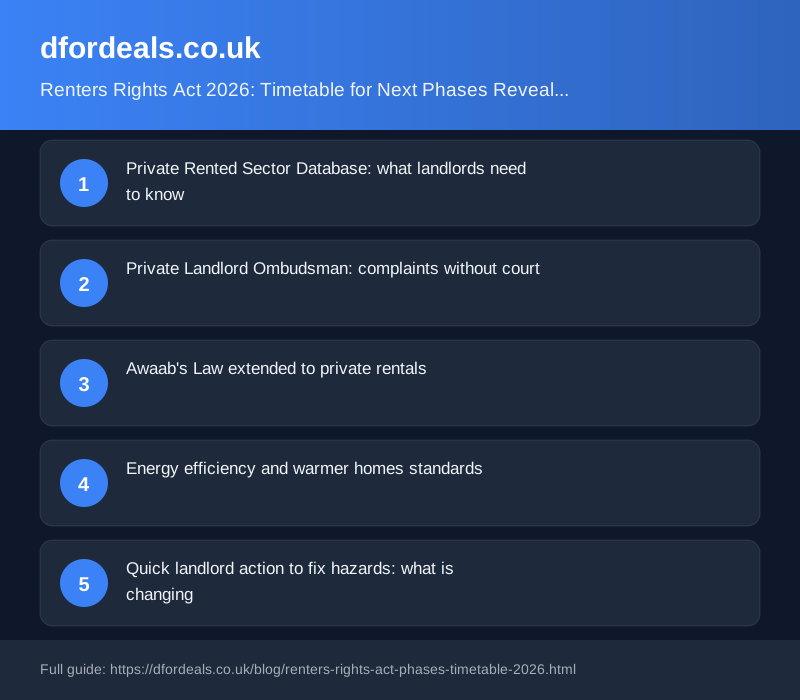
Private Rented Sector Database: what landlords need to know
The centrepiece of phase 2 is a new centralised register of every landlord and rental property in England. The government describes it as "a register of all landlords and rental properties in England, so you can check who you're renting from." It will be rolled out gradually by area from late 2026, meaning not every landlord will need to register on day one — but the rollout will be nationwide within a relatively short window.
Once live in a given area, tenants will be able to check whether their landlord is properly registered. For landlords, this creates a clear incentive to register early: being visibly on the database signals compliance and professionalism. Failure to appear on the register when it is active in your area will almost certainly carry enforcement consequences, though the precise penalty structure has not yet been published.
Our view is that this database is, in practical terms, inevitable and broadly positive. A single central register removes ambiguity about who is responsible for a property, makes it harder for rogue operators to hide, and gives compliant landlords a straightforward way to demonstrate their legitimacy. The administrative burden of registering is likely to be modest — name, contact details, property address and EPC rating — but the consequences of not registering will be severe.
If you let property in England, treat the database launch as a deadline, not an optional extra. When registration opens for your area, do it immediately.
Private Landlord Ombudsman: complaints without court
The second major pillar of phase 2 is a new independent Private Landlord Ombudsman. The government's own description frames it as a way to "help renters sort complaints against landlords quickly and fairly, without needing to go to court." It will also, notably, "support landlords with tools, guidance and training on handling complaints from tenants early."
This is worth pausing on. A free, independent complaints service that keeps disputes out of court benefits both sides — tenants get a faster, cheaper way to raise legitimate concerns, and landlords avoid the cost, stress and reputational damage of litigation over issues that could have been resolved earlier. The ombudsman will have the power to make binding rulings, which means getting complaint handling right before the scheme launches is essential.
For portfolio landlords, this has direct operational implications. Having a clear, documented complaints procedure in place — including response timeframes, escalation routes and record-keeping — will no longer be optional best practice. It will be effectively mandatory, because the ombudsman will expect to see evidence that you tried to resolve the issue before it was escalated.
The service is scheduled to launch from late 2026, in step with the PRS database. Our recommendation: review your existing complaints process now, while there is time to refine it without pressure.
Awaab's Law extended to private rentals
One of the most significant longer-term developments is the planned extension of Awaab's Law to the private rented sector. Named after two-year-old Awaab Ishak, who died from a respiratory condition caused by mould in his family's social housing home, Awaab's Law imposes strict timeframes on landlords to fix serious hazards after they are reported.
The government says it is "looking to extend Awaab's Law to private rentals — forcing landlords to act fast when homes are unsafe." A consultation on how best to do this will be launched soon, with the aim of giving private tenants "protections like those already supporting social housing tenants."
The implications are hard to overstate. Under Awaab's Law in the social sector, landlords must identify hazards within strict timeframes — typically 14 days for emergency repairs — and complete remedies within a further fixed period. Extending this to private rentals means that every damp spot, mould patch or faulty heating system becomes a time-limited compliance obligation, not just a maintenance issue.
If you have not already reviewed your property condition monitoring processes, now is the time. Regular, documented inspections and a clear system for logging and responding to tenant reports of damp or mould will be essential. The key word is documented — if you cannot prove you acted within the required timeframe, from the regulator's perspective you did not act at all.
This also links directly to the HHSRS overhaul coming into force on 23 June 2026, which introduces a three-tier hazard rating system and civil penalties of up to £40,000. The two regimes — HHSRS enforcement and Awaab's Law timeframes — will operate in parallel, meaning landlords face both immediate financial penalties for hazard non-compliance and mandatory remediation deadlines. For a detailed breakdown of the new HHSRS framework, see our full guide to the HHSRS 2026 changes.
Energy efficiency and warmer homes standards
The government has also confirmed it is "continuing work to improve living conditions in privately rented homes," with consultations that "will inform their timelines." The ambition is clear: future rules will "raise the standard of rented homes — tackling damp, mould and dangerous conditions" and require landlords to "fix serious hazards faster and make homes more energy efficient, helping tenants stay warm and cut bills."
This is the most open-ended of the announced plans, with no firm date for when new energy efficiency requirements will land. But the direction of travel is unambiguous. Minimum EPC standards — currently EPC E for new lets, with proposals to raise the floor to EPC C — are not going away. Combined with the warmer homes agenda, landlords should be planning for a future where EPC C is the baseline, not a stretch target.
If your portfolio includes properties with EPC D or E ratings, the economics of upgrading them need to be underwritten now, not when the regulations land. The gap between the cost of improvements and the rent premium they command is narrowing as energy prices remain elevated, so a well-timed upgrade can pay for itself in reduced void risk and higher achievable rent.
Quick landlord action to fix hazards: what is changing
Alongside the headline announcements, the government has confirmed it is looking at "quicker landlord action to fix hazards" as a standalone workstream. This is separate from the Awaab's Law extension, though clearly related. The focus is on creating a framework where hazards are identified and remediated faster than the current system allows, without necessarily waiting for a full statutory instrument.
What this looks like in practice is still emerging, but the pattern is consistent across every announcement: the government wants landlords to be proactive about property conditions, not reactive. Waiting for a tenant to complain before fixing a damp problem will no longer be commercially or legally viable. Regular property inspections — and documented evidence of them — are becoming the baseline expectation.
What this means for property investors
Taking these announcements together, the picture for landlords and property investors is clear: the regulatory burden on private renting is increasing structurally, and it is not going to reverse. That sounds daunting, but for investors who treat compliance as a cost of doing business — and who build it into their acquisition underwriting — the changes are manageable and, in some respects, positive.
- A single register means no hiding. Compliant landlords can demonstrate their status; non-compliant ones get filtered out, which reduces competition from below-market operators and supports rent levels.
- The ombudsman reduces legal costs. A free, independent complaints process means fewer small disputes end up in court. Landlords who handle complaints professionally will benefit from lower cost and faster resolution.
- Awaab's Law raises standards. The cost of fixing hazards early is almost always lower than the cost of enforcement, litigation and reputational damage. Proactive maintenance is cheaper than reactive crisis management.
- Energy efficiency adds portfolio value. Properties with strong EPC ratings command better refinance terms, lower void risk and premium rents. Upgrading now, when the cost of capital is relatively favourable, makes financial sense even before the regulations require it.
For a broader view on how current market conditions interact with these regulatory changes, read our UK property market update for May 2026, which covers the stabilising price environment and regional yield trends. And if you are planning your next acquisition, our property investment strategies guide walks through how to match your approach to current market conditions.
Practical steps to prepare now
The timetable for these changes is not years away. Phase 2 begins in late 2026 — roughly six months from today. Here is what we recommend doing between now and then:
- Audit your portfolio. Every property should have a current EPC, gas safety certificate, EICR and HHSRS assessment. Identify gaps and schedule remediation immediately.
- Document everything. If you do not already keep a digital log of inspections, repairs and tenant communications, start one. The ombudsman and Awaab's Law regime will require proof of action.
- Review your complaints procedure. Write a simple, documented process for receiving, logging and responding to tenant complaints. Include timeframes and escalation routes.
- Budget for energy upgrades. Properties below EPC C should have a capital plan for improvements. Prioritise the ones with the highest payback: insulation, efficient heating and double glazing.
- Talk to your mortgage broker. The compliance landscape affects refinance terms. Knowing what lenders expect on EPC and property condition will help you plan ahead.
Run the numbers on your next deal through our property calculators — the rental yield, SDLT, BRRR and deal analyser tools — to make sure the compliance costs are factored in from the start. The best time to discover that a property needs £15,000 of energy upgrades is before you exchange contracts, not six months later when the new regulations land.
The Renters Rights Act is not one event. It is a rolling programme of reform that will reshape the private rented sector over the next several years. Landlords who treat each phase as a compliance deadline to meet rather than a threat to resist will find that the changes, while demanding, are ultimately navigable — and that the market they leave behind has fewer rogue operators and better conditions for professionals who do the work properly.