Section 21 Abolished: A Landlord's Complete Guide to Section 8 Grounds (England 2026)
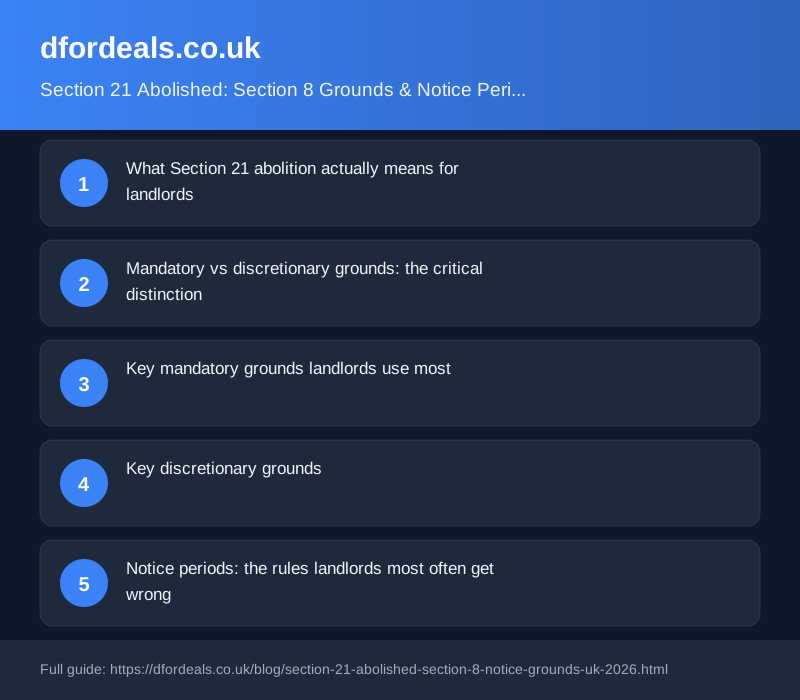 data-pin-media="https://dfordeals.co.uk/blog/images/section-21-abolished-section-8-notice-grounds-uk-2026.png" data-pin-description="Section 21 Abolished: A Landlord's Complete Guide to Section 8 Grounds (England 2026)" data-pin-url="https://dfordeals.co.uk/blog/section-21-abolished-section-8-notice-grounds-uk-2026.html"
Before the Renters' Rights Act came into force, UK landlords served around 14,000 Section 21 notices every quarter — a two-month notice requiring no reason and minimal paperwork. Every single one of those landlords now needs a different plan. A Section 21 notice served today is legally worthless.
The short answer: Section 8 is now the only legal mechanism in England to end a tenancy and recover possession of a property. It is not a single eviction power — it is a menu of 20-plus statutory grounds, each with its own trigger conditions, notice period, and evidential requirements. The mandatory grounds (where a court has no discretion to refuse) include serious rent arrears, the landlord intending to sell, and the landlord or family wanting to move in. Landlords who understand these grounds, and serve notice correctly, retain real power to recover their property when they need it.
What Section 21 abolition actually means for landlords
The Renters' Rights Act 2025 abolished Section 21 no-fault evictions and converted all existing assured shorthold tenancies (ASTs) in England into assured periodic tenancies — rolling on the original payment period (typically monthly). There are no new fixed-term ASTs: landlords cannot lock tenants into a term that prevents early departure, and equally cannot end a tenancy by giving two months' notice at term-end.
In practice, every pre-existing AST became a periodic tenancy when the Act came into force. New tenancies created since then are periodic from day one. A landlord who wants to recover possession must identify a valid statutory ground under Section 8, serve the correct notice in the prescribed form, wait out the notice period, and — if the tenant does not leave — apply to the county court. There is no shortcut.
"The abolition of Section 21 represents the most significant change to residential landlord-tenant law in England since the Housing Act 1988. Approximately 230,000 Section 21 notices were issued in the two years before the ban took effect." — Ministry of Justice, Mortgage and Landlord Possession Statistics, 2025
Mandatory vs discretionary grounds: the critical distinction
Section 8 grounds are listed in Schedule 2 of the Housing Act 1988, as extensively amended by the Renters' Rights Act 2025. They fall into two legally distinct categories that determine how much power the landlord has in court:
- Mandatory grounds: If the landlord proves the ground is met on the correct dates, the court must grant possession. The judge has no discretion to weigh whether eviction is reasonable. Possession is automatic once the ground is established.
- Discretionary grounds: Even if the ground is technically proven, the court may decline to grant possession if it considers eviction unreasonable in the circumstances. Judges use this discretion — particularly where rent arrears are modest, the tenant has a vulnerable family member, or the breach is minor.
For landlords, mandatory grounds are far more predictable. A contested discretionary ground hearing can take months and offers no guarantee of the outcome even if the landlord's case is legally sound.
Key mandatory grounds landlords use most
| Ground | Trigger | Notice period | Key restriction |
|---|---|---|---|
| Ground 8 | Rent arrears of at least 3 months outstanding at both the notice date and the court hearing date | 4 weeks | Arrears must persist to the hearing day — partial payment below the threshold defeats the ground |
| Ground 1 (new — sale) | Landlord intends to sell the property | 4 months | Cannot be used in the first 12 months of the tenancy |
| Ground 1A (new — occupation) | Landlord or specified close family member intends to occupy the property as their only or main home | 4 months | Cannot be used in the first 12 months of the tenancy |
| Ground 7A | Tenant or household member convicted of a serious offence at or near the property; or tenant subject to a Civil Injunction for anti-social behaviour | 4 weeks | Conviction or injunction must be relevant and recent |
| Ground 14A | Domestic abuse: one joint tenant has been subject to abuse by the other, and the perpetrator has left or been removed | Immediate (no minimum notice period) | Applies to joint tenancies only |
Ground 8 is the most commonly used mandatory ground in rent arrears cases. The critical detail — and the one most landlords overlook — is the dual-date requirement: arrears must still be at the qualifying level on the day of the court hearing, not just when the notice was served. A tenant who makes a partial payment in the weeks between the notice and the hearing can reduce arrears below the threshold, causing Ground 8 to fail. The Renters' Rights Act raised this threshold to three months' arrears, up from two months previously — giving tenants more room to reduce arrears before the mandatory ground is lost.
Grounds 1 and 1A — the new landlord-sale and landlord-occupation grounds — are a significant addition for landlords who need to sell or move in. Both carry a four-month notice period and both are protected by a 12-month bar: a landlord cannot invoke them in the first year of a tenancy. This means a landlord who signs a new tenancy and then decides three months later that they need to sell must wait until month 13 before the mandatory ground becomes available.
Key discretionary grounds
Discretionary grounds remain useful, but success is not guaranteed even if the ground is technically met. Courts will consider proportionality and all the circumstances before granting an order.
- Ground 10 (some arrears): Rent arrears below the three-month mandatory threshold. Courts frequently grant possession on this ground where arrears are persistent and the landlord has tried to resolve the situation — but a judge can refuse if the tenant has a compelling personal circumstance.
- Ground 11 (persistent delay): The tenant has persistently paid rent late, even if not currently in arrears at all. A documented history of late payment is sufficient — keeping a detailed rent ledger is essential.
- Ground 12 (breach of tenancy obligation): Any breach of a tenancy condition other than rent — common examples include damage to the property beyond fair wear and tear, unauthorised subletting, or keeping pets in breach of the tenancy agreement.
- Ground 13 (deterioration of property): The tenant or household member has caused the condition of the property or furniture to deteriorate through neglect or waste.
- Ground 14 (anti-social behaviour): The tenant or household member has caused nuisance or annoyance to neighbours, the landlord, or anyone in the vicinity of the property. No minimum notice period is required — the landlord can apply to court the same day the notice is served — but the court still retains full discretion over whether to grant an order.
- Ground 17 (misrepresentation): The tenancy was obtained through a false statement made by the tenant or a person acting at the tenant's request.
Notice periods: the rules landlords most often get wrong
Serving the wrong notice period invalidates the notice entirely, forcing the landlord to restart the process. The Renters' Rights Act extended notice requirements across most grounds. The table below summarises the most commonly used periods:
| Ground(s) | Notice period required |
|---|---|
| Ground 14 (anti-social behaviour) | None — immediate application to court |
| Ground 14A (domestic abuse, joint tenancy) | None — immediate application to court |
| Ground 8 (serious rent arrears) | 4 weeks |
| Ground 7A (serious conviction/injunction) | 4 weeks |
| Grounds 10, 11, 12, 13, 17 (various) | 4 weeks |
| Ground 1 (landlord intends to sell) | 4 months (and tenancy must be at least 12 months old) |
| Ground 1A (landlord/family to occupy) | 4 months (and tenancy must be at least 12 months old) |
The most common landlord error is carrying over the old Section 21 two-month notice period as a mental model. Section 8 notice periods are determined by the specific ground cited — using too short a period makes the notice invalid and the landlord must start the whole process again. Notice must always be served using the prescribed Form 3 (available from GOV.UK), completed in full, and served in the manner specified in the tenancy agreement or by first-class post with proof of postage.
The court process after notice expires
If a tenant does not leave by the expiry of the Section 8 notice, the landlord must apply to the county court for a possession order. For mandatory grounds (such as Ground 8 or Grounds 1/1A), the court will list a hearing at which the landlord simply needs to prove the ground conditions are met. For discretionary grounds, both parties attend a full hearing and present evidence; the judge then decides whether it is reasonable to grant possession.
The timeline from court application to enforcement is the single biggest financial risk in the new regime. Ministry of Justice data from 2025 puts the average time from landlord application to a possession order at four to six months. Enforcement via county court bailiff or High Court Enforcement Officer adds further weeks. During this period the landlord may receive no rent and is still liable for the property's costs and compliance obligations. For landlords facing serious arrears, modelling the cost of this window — lost rent, legal fees, and potential damage — before deciding whether to serve notice is not optional; it is basic deal arithmetic.
"Average county court listing times for contested possession hearings have increased to over six months in some regions in 2025, driven by court backlogs and rising caseloads in the private rented sector." — Law Commission, Private Rented Sector Report, 2025
Landlord compliance: the pre-conditions that determine whether Section 8 works
A landlord who has failed to comply with their basic legal obligations may find a possession claim struck out or delayed regardless of which ground is cited. Before serving any Section 8 notice, confirm the following:
- The tenant's deposit is protected in a government-approved custodial or insured scheme and the prescribed information was provided within 30 days of receipt
- A valid Gas Safety Certificate has been provided to the tenant annually
- An Electrical Installation Condition Report (EICR) has been carried out and provided to the tenant, and any required remedial work completed
- A valid EPC has been provided at the start of the tenancy (minimum EPC E rating currently required for new tenancies; EPC C required from 2028)
- The Government's How to Rent guide was provided at the tenancy commencement
Failure on any of these compliance points can bar a landlord from successfully obtaining possession, even where the substantive ground (such as serious arrears) is clearly made out. Compliance is not a background administrative task — it is the foundation on which the right to recover possession stands.
Practical checklist before serving Section 8
- Identify the correct ground(s) and confirm all conditions are met at the date of service
- Check the tenancy is old enough to use the chosen ground (12-month bar applies to Grounds 1 and 1A)
- Use the prescribed Form 3 from GOV.UK — do not use unofficial templates
- Calculate the correct notice period from the date of service, not from the date the notice is written
- Serve the notice correctly: by hand with a witness, first-class post with proof of posting, or as specified in the tenancy agreement
- For Ground 8, print and retain a full rent ledger showing arrears as at the notice date — you will need this at the court hearing
- Confirm all compliance obligations above are met before service
- Record and store all communication with the tenant in case of a disputed hearing
Frequently asked questions
Can a landlord still evict a tenant in England without giving a reason?
No. Section 21 no-fault evictions are abolished under the Renters' Rights Act 2025. A landlord must use Section 8, citing one or more valid statutory grounds. If no ground currently applies, the landlord cannot require the tenant to leave — the tenancy continues until a ground arises or the tenant chooses to end it.
What is the fastest Section 8 ground for UK landlords?
Ground 14 (anti-social behaviour) and Ground 14A (domestic abuse between joint tenants) carry no minimum notice period — the landlord can apply to court as soon as notice is served. Ground 8 (serious rent arrears of at least 3 months) requires four weeks' notice. Despite this, total process time from first notice to enforcement typically runs four to six months regardless of which ground is used, because of county court waiting times.
What happens if a tenant partly pays off arrears before the court hearing?
If arrears fall below the three-month threshold between the notice date and the court hearing, Ground 8 (mandatory) is no longer available. The landlord would need to rely on Ground 10 (some arrears, discretionary) or Ground 11 (persistent late payment, discretionary). Keeping meticulous rent ledger records is essential — the court will scrutinise the entire payment history, not just the arrears at one point in time.
What compliance obligations must a landlord meet before serving Section 8?
Landlords who have failed to protect the deposit, provide a Gas Safety Certificate, provide an EICR, or provide the How to Rent guide may find their possession claim struck out or suspended. These compliance requirements are not procedural technicalities — courts have used non-compliance to deny possession orders even where the substantive arrears or breach ground is clearly proven. Confirm all obligations are met before serving any notice.