UK Selective Licensing 2026: Which Councils Run Schemes, What Licences Cost and How Landlords Must Comply
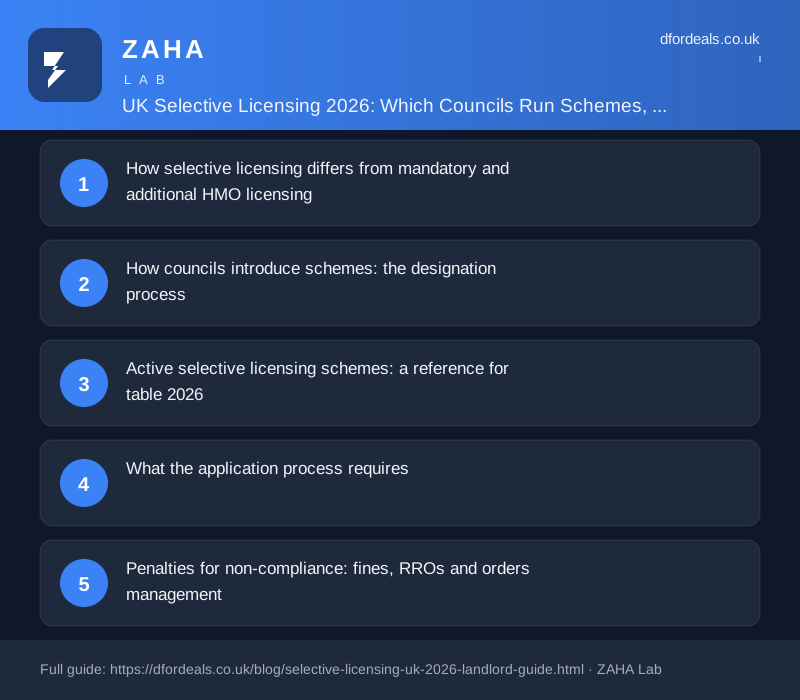
A landlord operating a two-bedroom terraced house in Liverpool was handed a £17,500 civil penalty in early 2026 for renting without the required selective licence — on a property she had owned for eleven years, in an area that became a scheme zone after she bought it. She had simply never checked. With more than 70 active selective licensing schemes across England as of October 2026, and the Renters' Rights Act 2025 handing councils significantly stronger enforcement powers, landlords who have not verified their compliance position should do so this week.
Selective licensing is a local authority scheme under Part 3 of the Housing Act 2004 that requires every private landlord in a designated area to hold a licence from the council, regardless of property type or size. In October 2026, active schemes cover parts of every major English city, with five-year licence fees typically running between £500 and £900 per property. Operating without one is a civil offence carrying penalties of up to £30,000, and tenants can additionally pursue a Rent Repayment Order for up to 12 months' rent regardless of whether they paid it themselves.
How selective licensing differs from mandatory and additional HMO licensing
Three distinct licensing regimes apply to private landlords in England. Understanding which applies is the first compliance step:
- Mandatory HMO licensing (national). Applies to all rented properties with five or more occupants forming two or more households, sharing facilities. This has been in force nationally since 2018 and is not council-discretionary — every such property in England requires a licence from its local authority.
- Additional HMO licensing (discretionary). Councils can extend licensing to smaller HMOs with fewer occupants (commonly three- or four-bedroom shared houses with two households or more). Whether this applies depends on whether your council has designated an additional licensing scheme in your area.
- Selective licensing (discretionary). Applies to all privately rented properties in a council-designated zone, regardless of household size or occupancy type. A standard two-bedroom flat let to a couple requires a selective licence just as much as an HMO does in a selective zone.
It is possible for a property to be subject to both additional HMO licensing and selective licensing simultaneously if it sits in a scheme area — though the council may issue a combined licence. Landlords of larger HMOs in selective zones still need their mandatory HMO licence separately.
How councils introduce schemes: the designation process
A council cannot introduce selective licensing unilaterally for large areas. Under the Housing Act 2004 (as amended), any scheme covering more than 20% of the council's geographic area or more than 20% of its private rented housing stock requires approval from the Secretary of State at MHCLG before it can be designated. Smaller, targeted schemes can proceed through a council resolution alone after a statutory consultation period of at least ten weeks.
Councils must demonstrate one or more of the following conditions applies to the area they wish to designate:
- Low housing demand (or likely to become so)
- Significant and persistent anti-social behaviour problems
- Poor property conditions
- High levels of deprivation
- High levels of migration
"According to MHCLG licensing data published in Q2 2026, 73 selective licensing schemes were active across England, covering an estimated 340,000 privately rented dwellings. A further 14 schemes had received council designation approval and were due to come into force before the end of 2026." (Source: MHCLG Private Rented Sector Licensing Dashboard, Q2 2026)
Active selective licensing schemes: a reference table for 2026
The table below covers major active schemes as of October 2026. Fees shown are indicative of the standard rate for a single landlord; many councils offer reduced rates for accredited landlords or portfolio discounts. Always verify current fees and zone boundaries with the relevant council before completing an acquisition in an area that may be designated.
| Council / Area | Scheme coverage | Indicative fee | Scheme term |
|---|---|---|---|
| Nottingham City | City-wide (entire PRS) | £780 | 2023–2028 |
| Liverpool City | Multiple designated zones | £700 | 2022–2027 |
| Salford | City-wide | £650 | 2024–2029 |
| Hull | Multiple wards | £500 | 2023–2028 |
| Blackpool | Central and South Shore wards | £450 | 2022–2027 |
| Newham (London) | Borough-wide | £900 | 2023–2028 |
| Barking & Dagenham | Borough-wide | £850 | 2024–2029 |
| Waltham Forest | Multiple designated wards | £870 | 2023–2028 |
| Croydon | Broad Green & surrounding wards | £750 | 2023–2028 |
| Bristol | Three designated zones | £690 | 2024–2029 |
Note: zone boundaries and fees change when schemes are renewed. The MHCLG maintains a public register of approved schemes, and councils typically require a new licence application if a scheme is redesignated rather than simply renewed in the same form.
What the application process requires
A selective licence application is submitted to the local council's private sector housing team. The process differs in detail by council but the standard requirements are consistent:
- Valid Gas Safety Certificate (GSC). An annual certificate from a Gas Safe registered engineer confirming all gas appliances and flues are safe. Must be current at application and renewed annually during the licence term.
- Electrical Installation Condition Report (EICR). A full inspection of the fixed wiring, carried out by a qualified electrician, valid for up to five years. As of 2020, EICRs are also mandated nationally for all new tenancies.
- Energy Performance Certificate (EPC), minimum Band E. From April 2025, an EPC below Band E renders a property unlettable (subject to registered exemptions). Councils may also use EPC data to prioritise enforcement activity against the worst-performing stock.
- Smoke and CO alarms compliant with Smoke and Carbon Monoxide Alarm Regulations 2022. A working smoke alarm on each storey and a CO alarm in any room with a solid fuel appliance.
- Details of management arrangements. If managed by a letting agent, the agent's name, address and relevant contact details. Councils may inspect management practices as a condition of granting the licence.
- Declaration of fit and proper person status. The landlord (and any managing agent) must declare no relevant criminal convictions, civil penalties, or prior licence refusals.
Most councils process straightforward applications within 8–12 weeks and issue the licence with conditions attached. Licence conditions commonly require that tenant references are obtained and retained, that occupancy is not permitted to exceed a stated maximum, and that tenants are provided with an inventory at the start of each tenancy.
"ONS Private Rental Market Statistics for Q2 2026 show that average private rents in England rose 5.2% year-on-year, with the highest growth in London (6.1%) and the East Midlands (5.9%) — the two regions with the highest concentration of active selective licensing schemes. The correlation reflects why affordability pressure continues to motivate councils to introduce schemes even where underlying housing conditions have stabilised." (Source: ONS Private Rental Market Statistics, Q2 2026)
Penalties for non-compliance: fines, RROs and management orders
The penalty framework for selective licensing non-compliance is significantly more robust in 2026 than it was five years ago. Landlords operating without a licence face three concurrent enforcement routes:
- Civil penalty notice. Under the Housing Act 2004 (s.72), operating an unlicensed property that requires a selective licence is a criminal offence. Councils can alternatively issue a civil penalty of up to £30,000 per property in lieu of prosecution. Most enforcement-active councils use civil penalties as the primary route because they are faster and require a lower evidential threshold than a criminal prosecution.
- Rent Repayment Order (RRO). A tenant (or former tenant) can apply to the First-tier Tribunal (Property Chamber) for an order requiring the landlord to repay up to 12 months' rent received while the property was unlicensed. The Renters' Rights Act 2025 extended RRO eligibility to Universal Credit claimants and removed the need for the tenant to have paid rent personally — a local authority can apply on behalf of a claimant where housing costs were paid direct to the landlord. An RRO does not require a conviction and is pursued independently of any civil penalty.
- Interim and final management orders. Where a landlord fails to apply for a licence despite council notice, or where a licence application is refused, the council may apply to take over management of the property through an interim management order (IMO) lasting up to 12 months, followed by a final management order of up to five years. Rental income passes to the council during the management order period, net of management costs. The landlord retains legal ownership but cannot access the rent or retake possession without the Tribunal's leave.
The combination of a £30,000 civil penalty and a 12-month RRO on a property generating £900/month would total a worst-case exposure of £40,800 — more than a year's gross rent on most properties outside central London, and substantially more than the cost of licensing compliance.
Should investors buy in selective licensing areas?
Many landlords treat selective licensing as a deterrent to acquisition. The more accurate framing is that selective licensing is a recurring operating cost that must be modelled into the deal from the outset. A £780 licence fee on a five-year term equates to £156 per year, or approximately 1.4% of annual gross rent on a £900/month property. That is material but not deal-breaking, especially in high-yield Northern markets where the schemes are most prevalent.
Three acquisition considerations for scheme areas:
- Factor the licence into the hold-cost model. A five-year licence that falls due for renewal mid-way through an ownership period creates a cashflow event. Model two or three licence cycles across a ten-year hold if your underwriting extends that far.
- Verify zone boundaries before exchange. Scheme zones are defined at ward or sometimes street level. A property two streets from the boundary may or may not be in scope. Check the council's official zone map using the full postcode, not the approximate area, before committing.
- Use scheme existence as a negotiating lever. A vendor who is not licenced in a scheme area has an undisclosed legal liability attached to the property. That can support a price reduction or a licence-cost retention from completion funds, subject to your solicitor's advice.
Frequently asked questions
What is selective licensing and does it apply to all landlords in the designated area?
Selective licensing is a mandatory scheme introduced by a local council under Part 3 of the Housing Act 2004, requiring all private landlords in a designated zone to hold a council-issued licence for each property they rent. Unlike mandatory HMO licensing, which applies only to larger shared houses, selective licensing covers all privately rented accommodation in the zone — including standard single-let flats and houses occupied by one household. There are no exemptions for short-term or holiday lets registered under the furnished holiday letting rules, though properties exempt from private rented sector regulation (council housing, housing association properties) are outside scope.
How much does a selective licence cost in 2026?
Selective licence fees range from approximately £350 to £950 per property for a five-year term, depending on the council. London boroughs typically charge £700–£950, while councils in the North and Midlands charge £400–£750. Some councils offer a 10–20% discount for landlords who are accredited members of the National Residential Landlords Association or a council-approved scheme. The fee covers the application, inspection, and administration for the full licence term; annual renewal fees are not charged separately in most schemes. The fee is non-refundable if the application is refused, though landlords may appeal to the Residential Property Tribunal.
Can a tenant apply for a Rent Repayment Order if a property is unlicensed?
Yes. Under the Housing and Planning Act 2016 (as strengthened by the Renters' Rights Act 2025), a tenant can apply to the First-tier Tribunal for a Rent Repayment Order requiring the landlord to repay up to 12 months' rent. The RRO applies to rent paid during any period when the property was required to hold a selective licence but did not. The tenant does not need to prove the landlord was aware of the scheme — operating an unlicensed property in a selective zone is strict liability for RRO purposes. Universal Credit claimants can have an RRO pursued on their behalf by the local authority even where housing costs were paid directly by DWP to the landlord.
This article is for information only and does not constitute legal advice. Licensing requirements, zone boundaries, and fee levels change when schemes are redesignated. Always verify the current position with the relevant local authority before letting or acquiring a property in a potential scheme area.