UK Property Crowdfunding 2026: Returns, Risks and How It Really Works
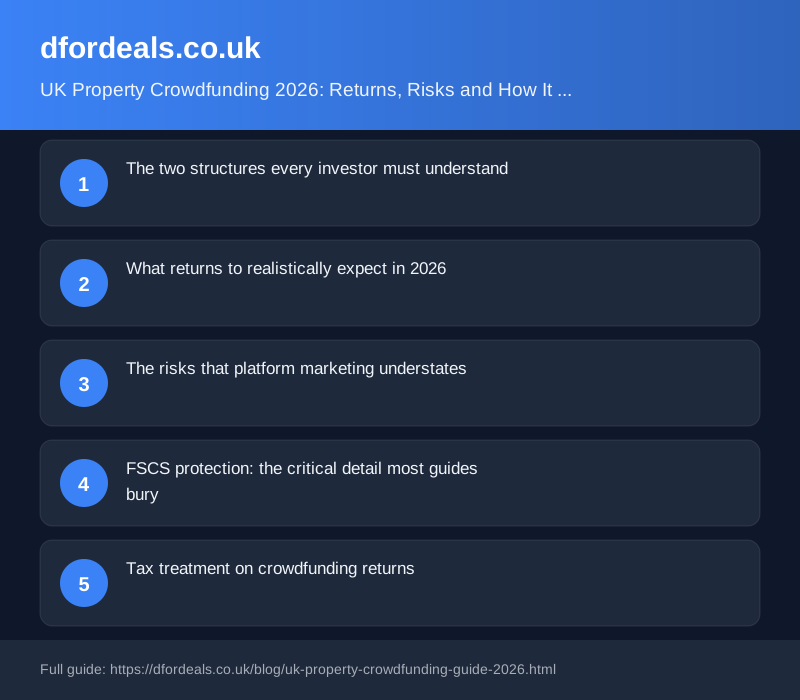 data-pin-media="https://dfordeals.co.uk/blog/images/uk-property-crowdfunding-guide-2026.png" data-pin-description="UK Property Crowdfunding 2026: Returns, Risks and How It Really Works" data-pin-url="https://dfordeals.co.uk/blog/uk-property-crowdfunding-guide-2026.html"
UK property crowdfunding platforms advertise target returns of 7–14% a year — yet the Financial Services Compensation Scheme provides no protection if a platform fails or a deal goes wrong. Most investors discover this only after they have committed their capital.
The short answer: UK property crowdfunding lets you pool money with other investors to access property-backed returns from as little as £100 — no mortgage, no deposit, no landlord obligations. Two main structures dominate the market: equity crowdfunding, where you share in rental income and capital growth; and debt or development crowdfunding, where you lend against a property asset at a fixed interest rate. The structure you choose determines your return profile, tax treatment, liquidity, and what happens when things go wrong.
The two structures every investor must understand
The single most important question when evaluating any UK property crowdfunding opportunity is whether you are looking at an equity deal or a debt deal. They look similar on the surface but carry fundamentally different risks and investor rights.
Equity crowdfunding
In an equity structure, investors collectively purchase shares in a Special Purpose Vehicle (SPV) that owns the property. Returns come from two sources: rental income distributed periodically as dividends, and capital appreciation crystallised when the property is sold. As an equity investor you sit at the bottom of the capital stack — if the SPV carries mortgage debt and the property falls in value, equity holders absorb the loss first, ahead of any secured lender.
Debt and development finance crowdfunding
In a debt structure, investors lend money to a property developer or borrower, secured against the property by a legal charge. The borrower pays a fixed or variable interest rate, and investors receive regular interest payments. At term end, the loan is repaid and capital returned — provided the borrower can repay and the property value covers the loan in an enforcement scenario. Debt investors sit above equity in the capital stack: in a default, proceeds from selling the secured asset flow to debt investors first.
| Feature | Equity crowdfunding | Debt / development crowdfunding |
|---|---|---|
| Return type | Rental income + capital growth (variable) | Fixed or variable interest rate |
| Advertised target return | 4–8% pa (blended income + growth) | 7–14% pa (interest) |
| Capital stack position | Bottom — equity absorbs losses first | Top — repaid before equity in insolvency |
| Typical investment term | 3–5+ years | 6–24 months |
| IFISA eligible? | Generally no | Often yes (verify per platform) |
| FSCS protected? | No | No |
What returns to realistically expect in 2026
Published target returns vary significantly between platforms and deal types. Equity platforms typically advertise blended annual returns of 4–8%, combining a rental income yield of 3–5% with projected capital appreciation. Debt and development finance platforms typically quote 7–14% annual interest, with shorter-duration deals — six to twelve months — often at the higher end of that range.
The critical word throughout is target. Returns depend on the performance of the underlying asset, platform fees (typically 0.5–2% annually on equity platforms, sometimes embedded in the gross interest rate on debt platforms), vacancy rates, construction overruns on development deals, and wider property market conditions.
"UK average house prices rose 5.4% in the year to March 2026, the strongest rate of annual growth since mid-2022, driven by continued undersupply of housing against resilient buyer demand in most regions." — Land Registry UK House Price Index, April 2026 release
For debt deals specifically, the Loan-to-Value ratio matters as much as the headline rate. A loan at 65% LTV against a well-valued residential property in a liquid market is a materially different risk proposition to an 85% LTV development loan in a regional market with thin buyer demand. Always check the LTV, the independent valuation date, and the borrower's exit strategy before comparing headline interest rates between deals.
The risks that platform marketing understates
FCA-regulated platforms are required to carry clear risk warnings. Read them. The most significant risks in practice are:
- Illiquidity: Most crowdfunding investments cannot be sold before the term ends. Some equity platforms operate secondary markets, but these are thinly traded and a buyer at your preferred price is not guaranteed. Treat your capital as locked up for the full term from day one.
- Platform insolvency: If the platform itself fails, your investment may be frozen in administration proceedings. FCA authorisation requires platforms to hold client assets separately from their own funds — but wind-down procedures can take months or years and recovery of capital is not guaranteed.
- Deal failure: On development finance deals, construction delays, cost overruns, and valuation shortfalls can prevent the borrower repaying on schedule. On equity deals, a prolonged void period or unexpected major repair can eliminate a year's income. Neither outcome is unusual in UK property.
- Valuation risk: The property securing or generating your returns is valued at a point in time. A valuation from 18 months ago supporting a 70% LTV loan may now represent 80%+ LTV if local prices have moved against the deal.
- Concentration risk: Putting all crowdfunding capital into one or two deals on a single platform means a single deal failure can devastate the whole position. Spread across multiple deals and platforms to reduce this.
FSCS protection: the critical detail most guides bury
The Financial Services Compensation Scheme protects bank deposits up to £85,000 per institution and certain authorised investment products — but it does not protect property crowdfunding investments. This is not a technicality: the FCA's framework for investment-based crowdfunding explicitly excludes FSCS coverage from applying to the underlying investment returns or capital.
FCA authorisation does require that platforms segregate client assets from their own funds and maintain adequate capital. This reduces (but does not eliminate) the risk that a platform failure takes client money with it. But if the underlying property deal fails — the developer defaults, the property falls in value, the borrower cannot repay — no government compensation scheme stands between you and the loss.
"Investment in loans through peer-to-peer and crowdfunding platforms is not covered by the Financial Services Compensation Scheme. You may not get back the full amount invested." — Financial Conduct Authority, Consumer Warning on Crowdfunding, 2025
Tax treatment on crowdfunding returns
Tax treatment depends on the deal structure and whether the investment is held inside an ISA wrapper.
- Debt crowdfunding interest: Taxed as savings income. Basic-rate taxpayers receive a £1,000 Personal Savings Allowance; higher-rate taxpayers £500; additional-rate taxpayers nil. Interest above the allowance is taxed at your marginal rate. If held in an Innovative Finance ISA (IFISA), all interest is sheltered from Income Tax.
- Equity crowdfunding rental income: Taxed as property income at your marginal rate after allowable expenses. The £1,000 property allowance applies if total annual property income is below that threshold.
- Capital gains on equity disposals: Subject to CGT. For residential property, the rates are 18% (basic rate) and 24% (higher rate) above the £3,000 annual CGT exemption for 2026/27. Losses from one deal can be offset against gains from others in the same tax year.
The IFISA is a meaningful shelter for higher-rate taxpayers who have used their Personal Savings Allowance. The annual ISA subscription limit of £20,000 applies across all ISA types combined. Verify that the specific platform and deal type qualifies before assuming IFISA tax treatment applies — not all debt platforms hold IFISA manager status.
How to evaluate a UK property crowdfunding platform
Deal quality, fee transparency, and investor communication vary widely between platforms. Before committing capital, work through this checklist:
- Confirm FCA authorisation on the FCA Financial Services Register — do not rely on the platform's own claim of regulation
- Review the platform's default and recovery track record: how many loans have defaulted, how much capital was recovered, and over what timeframe
- Read the full key risk warnings document, not just the headline return figure
- Check whether client money is held in a segregated account at a regulated bank
- Understand the complete fee structure: origination fees, ongoing platform fees, exit fees, and whether they are deducted before or after the advertised rate
- For development deals: check LTV, independent valuation date, borrower track record, and the exit strategy — sale or refinance, and how realistic each is in the current market
- Check whether a secondary market exists and, if so, examine actual trading volume and average days to sell rather than assuming the feature provides genuine liquidity
Property crowdfunding vs buy-to-let: a frank comparison
| Factor | Property crowdfunding | Direct buy-to-let |
|---|---|---|
| Minimum capital | £100–£1,000 | £25,000–£60,000+ (deposit + costs) |
| Control over the asset | None | Full |
| Leverage available | Pre-structured into deal only | Yes — typically up to 75% LTV mortgage |
| Ongoing management | Nil | Significant (or ongoing letting agent cost) |
| Liquidity | Low — locked for deal term | Low — selling takes weeks to months |
| FSCS protection | No | No |
| Regulatory overhead | None — platform manages compliance | High — EPC, MEES, HHSRS, Section 8 process |
| Tax complexity | Moderate | High — Section 24, SDLT surcharge, CGT on disposal |
Property crowdfunding is not a substitute for direct buy-to-let for investors who want mortgage leverage and asset control. It is a different product category entirely — one suited to investors who want passive, property-backed income without the operational demands of being a landlord, and who are comfortable with illiquidity and platform risk in exchange for target returns that substantially outpace most savings accounts.
Frequently asked questions
Is UK property crowdfunding safe?
All legitimate UK property crowdfunding platforms must be FCA-authorised. However, FCA authorisation does not protect your capital — the FSCS does not cover crowdfunding investments. If the underlying deal fails or the platform becomes insolvent, you can lose some or all of your investment. Diversify across multiple platforms and deals, and only invest money you can afford to lock away for the full term.
What returns does UK property crowdfunding pay?
Equity platforms typically advertise blended target returns of 4–8% per year (rental income plus projected capital growth). Debt and development finance platforms typically advertise 7–14% annual interest. These are target returns, not guaranteed. They depend on underlying deal performance, platform fees, and market conditions. Always check a platform's historical default and recovery data independently before committing capital.
Can I hold property crowdfunding in an ISA?
Some FCA-authorised debt-based platforms offer an Innovative Finance ISA (IFISA), sheltering interest income from Income Tax within the £20,000 annual ISA subscription limit. Equity crowdfunding platforms generally do not qualify for IFISA status. Verify eligibility for the specific platform and deal type before assuming ISA tax treatment applies.
How is UK property crowdfunding taxed?
Debt crowdfunding interest is taxed as savings income: basic-rate taxpayers receive a £1,000 Personal Savings Allowance, higher-rate taxpayers £500. Interest above the allowance is taxed at your marginal rate. Equity crowdfunding rental income is taxed as property income. Capital gains on equity disposals attract CGT at 18% or 24% (residential rates) above the £3,000 annual exemption for 2026/27. IFISA-wrapped returns are sheltered from both taxes.