Article 4 Directions: Why Some Houses Can't Become Small HMOs
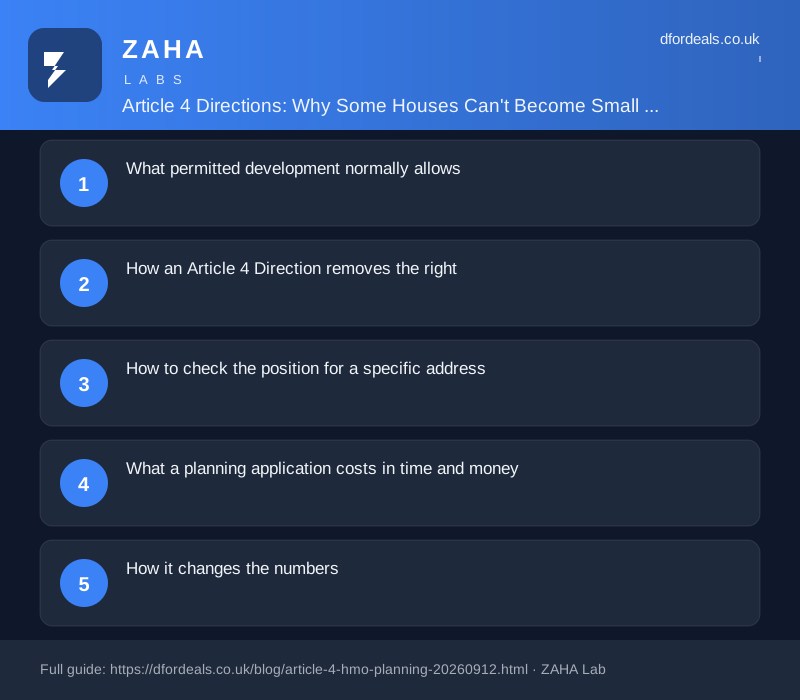
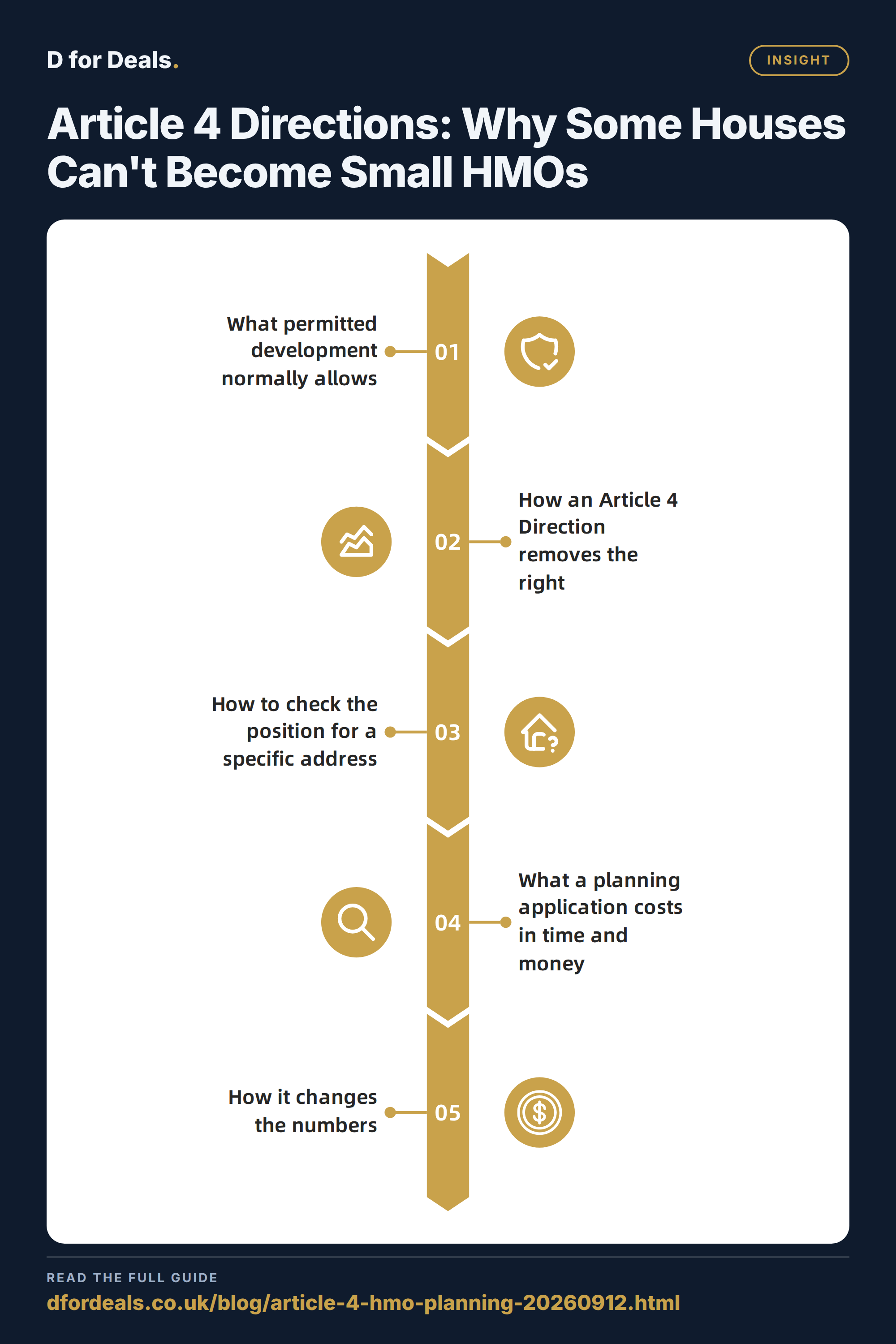
An Article 4 Direction is a planning tool that removes permitted development rights in a defined area, meaning a small house cannot be converted into a small HMO without first obtaining planning permission. Where a direction is in force, the conversion moves from a prior approval or permitted development route into a full planning application, which changes the cost, timeline and risk profile of the project. The position varies by address, so it must be confirmed with the local planning authority for the specific property before any purchase or works begin.
What permitted development normally allows
In England, the Use Classes Order allows certain changes of use without a planning application. A dwellinghouse in the C3 class can, in many areas, be converted to a small HMO in the C4 class under permitted development rights. A small HMO is generally one occupied by between three and six unrelated people who share facilities such as a kitchen or bathroom.
This route is attractive because it avoids the time, cost and uncertainty of a full planning application. The landlord or buyer notifies the authority where a prior approval process applies, or simply proceeds where the change is permitted outright. The property can then be let on a room-by-room basis rather than as a single household.
Permitted development rights are not absolute. They can be withdrawn by the local authority, by condition on a previous permission, or by an Article 4 Direction. They also do not override building regulations, licensing or other statutory controls.
How an Article 4 Direction removes the right
An Article 4 Direction is made by the local planning authority under the Town and Country Planning Act. It withdraws specified permitted development rights in a defined area, which may be a single street, a ward or the whole borough. When it covers the conversion of a dwellinghouse to a small HMO, the change of use requires planning permission.
The direction does not ban HMOs. It removes the automatic right and places the decision with the planning committee or officers under the development plan. Applications are then assessed against local policies on housing mix, amenity, parking, refuse and concentration of shared housing.
Directions can be introduced with immediate effect or subject to consultation and confirmation. Some authorities have borough-wide directions, while others target areas with high concentrations of shared housing or pressure on parking. A buyer must confirm whether a direction is in force, what area it covers, and whether it has been confirmed or is still temporary.
How to check the position for a specific address
Start with the local planning authority for the property. Ask for written confirmation of whether an Article 4 Direction affecting C3 to C4 conversions applies to that address. The relevant document is the direction itself, together with any confirmation notice and the policies it sits alongside.
Check the authority's online planning policy pages and its interactive policies map, which usually shows Article 4 areas. Then check the planning history for the address and neighbouring properties to see whether similar conversions have been approved, refused or enforced against. A refused or enforced conversion nearby is a signal that the authority is applying the policy actively.
Also check whether a previous planning permission for the property carries a condition removing permitted development rights. Conditions can be imposed on extensions, conversions or new-build homes and can have the same practical effect as a direction. The title register and any transfer documents may also contain restrictive covenants that limit use, which is a separate legal matter from planning.
What a planning application costs in time and money
Where a direction applies, the project needs a full planning application for change of use. The fee is set nationally and is payable to the authority; the exact figure depends on the application type and any exemptions, so it must be confirmed with the authority for the specific proposal. Professional fees for drawings, a planning statement, transport or noise assessments and agent time are additional and vary with the complexity of the site.
Time is the larger cost. A householder or minor commercial application is typically determined within a statutory period of around eight weeks, but change of use applications are often major or minor commercial and can take longer. Pre-application advice, validation queries, consultation and possible committee referral all extend the programme. An appeal adds months further.
The table below sets out the practical differences between the two routes.
| Factor | Permitted development route | Article 4 route |
|---|---|---|
| Planning consent | Not required for the change of use, subject to prior approval where applicable | Full planning permission required |
| Decision maker | Prior approval process or none | Planning officers or committee against local policy |
| Typical timeline | Weeks, where prior approval applies | Months, including pre-application and determination |
| Cost | Limited to notification and professional input | Application fee plus professional fees |
| Outcome risk | Low, subject to conditions | Refusal possible; appeal may be needed |
| Effect on value | HMO use can be implemented quickly | Value depends on consent being granted |
How it changes the numbers
The yield calculation changes because the acquisition price, the works cost and the void period all shift. A property with permitted development rights can be converted and let sooner, so rental income starts earlier. Where a direction applies, the buyer carries the cost of the application and the risk of refusal, and the property may sit empty or under-let during the process.
Funding is affected because lenders and valuers assess the property on its existing use until consent is granted. A mortgage or bridging facility secured against a C3 dwelling may not reflect the HMO income until planning permission is in place. Some lenders will not release funds for an HMO conversion without consent, which means the buyer needs cash or alternative finance to cover the application period.
The exit is also affected. A consented HMO may be valued on its income, while a property without consent is valued as a single dwelling. If consent is refused, the buyer is left with a C3 house, the sunk cost of the application, and a use that may be restricted by the direction. That outcome must be modelled before exchange, not after.
What to check next
Confirm the position with the local planning authority in writing for the specific address, asking whether an Article 4 Direction applies, whether it is confirmed, and what evidence the authority expects with an application. Obtain the direction document and the relevant local plan policies, and check the planning history and any conditions on the property's previous permissions.
Then calculate the project on both bases: the permitted development case and the full application case. Include the application fee, professional fees, the extended void period, finance costs during the process, and a refusal scenario in which the property reverts to single-household use. Compare the resulting income and exit value against the purchase price and works budget.
Finally, check licensing, building regulations, fire safety and any restrictive covenants, as these apply regardless of the planning route. The planning position, the legal position and the funding position must all be confirmed for the individual property before a decision is made.