Bridging Costs: How to Price Speed on a Refurbishment Project
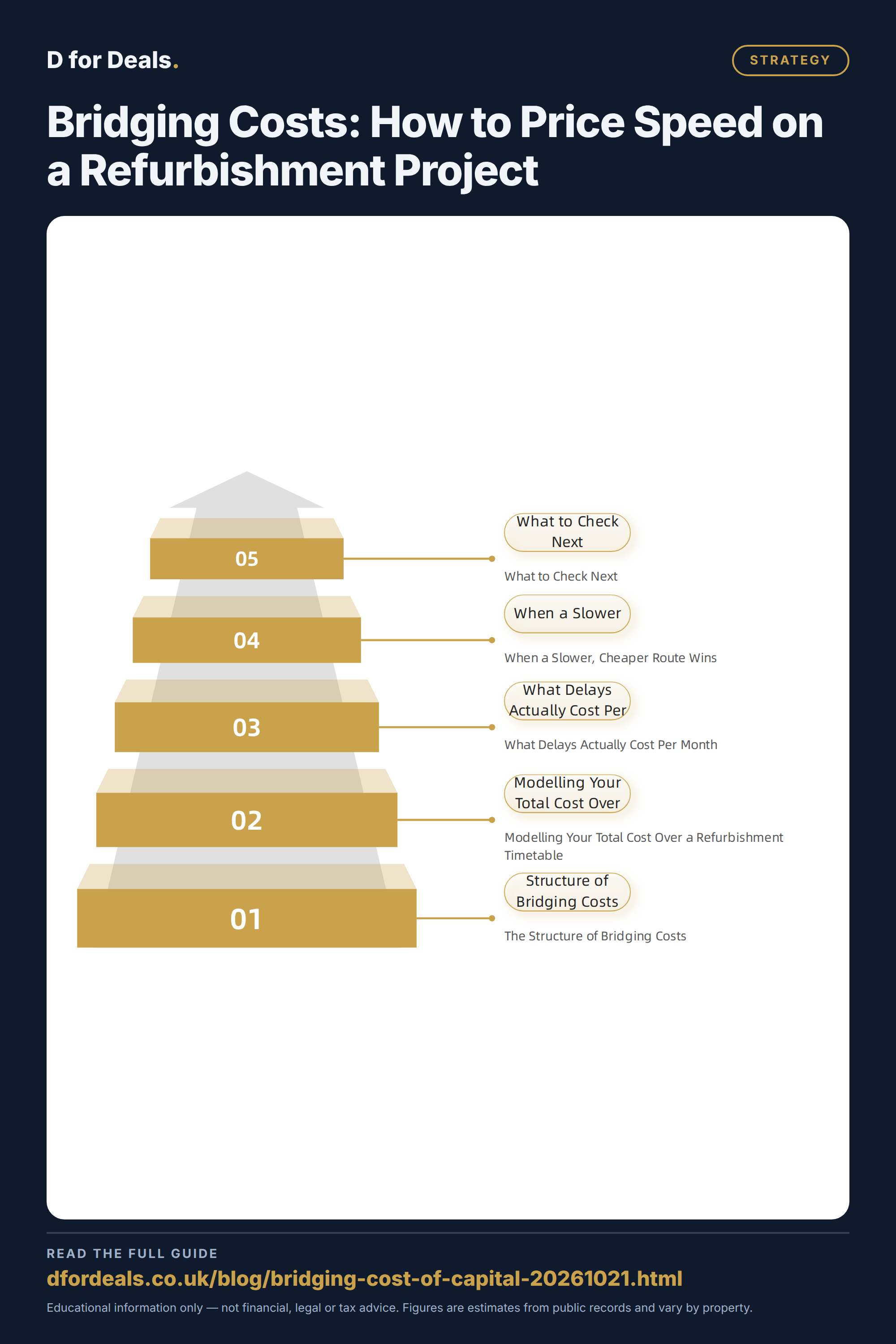
Bridging finance allows property investors to move quickly when refurbishing, but the cost structure is complex and heavily weighted toward execution timeline. The true cost of capital depends on three components: arrangement fees, monthly interest, and exit costs. Understanding how to model these costs against your planned refurbishment schedule is essential to knowing whether speed is worth its price, or whether a slower, cheaper financing route would deliver better returns.
The Structure of Bridging Costs
Bridging loans charge three distinct components. An arrangement fee is levied upfront as a percentage of the loan amount, covering the lender's administrative setup and underwriting. This fee is non-refundable and payable before drawdown, making it a sunk cost from day one.
Monthly interest accrues throughout the loan term, expressed as a percentage of the amount borrowed. A loan running twelve months accrues twelve months of interest; a loan running six months accrues six. This is the variable element—and why timeline slip is so costly.
An exit fee (sometimes called a take-out fee) applies when you repay or refinance, again expressed as a percentage of the original loan amount. Together, these three elements determine total cost of the facility, each proportional to loan size and duration.
Modelling Your Total Cost Over a Refurbishment Timetable
To calculate true cost of capital, work backward from your planned completion date. Begin with the arrangement fee—a fixed upfront cost, usually quoted as a percentage. For example, on a semi-detached property with a median sale price of £275,000 according to public sale-price records, if you bridge the full purchase price, this fee is calculated on £275,000.
Establish your monthly interest rate and multiply it by the number of months your refurbishment is expected to take. A three-month refurbishment costs dramatically less in interest than a six-month one, even at identical monthly rates. The difference compounds quickly—a six-month slip adds six months of interest on the full loan amount.
Add your exit fee, again as a percentage of the loan. On some products this is fixed; on others it is calculated on outstanding balance. Clarify this in writing. The sum of arrangement plus cumulative monthly interest plus exit fee gives your total cost. Express this both as absolute pounds and as a percentage of purchase price, so you can compare against alternative routes. Revise this calculation whenever your timeline changes, since interest is the variable element.
What Delays Actually Cost Per Month
Each month beyond your planned timeline adds a full month of interest charges to your bill. If your lender quotes a monthly rate, one calendar month of slip costs exactly one month of that rate on the full loan amount. But delays also have indirect effects: a refurbishment slip may push your exit date beyond favourable market conditions, or may cause you to miss mortgage lending criteria when refinancing.
By isolating the per-month cost in absolute pounds, you can quantify what a delayed planning decision, labour shortage, or supply-chain problem actually costs in cash. Many investors find that once they see this figure, they reallocate resources aggressively to stay on schedule—hiring additional trades, paying premium material rates, or managing the site more closely suddenly looks cheap against per-month bridging costs.
When a Slower, Cheaper Route Wins
Not all refurbishments benefit from bridging. A property requiring a twelve-month refurbishment may find that total bridging cost (arrangement plus accrued interest plus exit) exceeds any benefit gained from faster completion. A standard mortgage, even covering a longer timeline, may deliver lower total interest costs.
Conversely, a tight refurbishment window—eight to twelve weeks—may recover bridging's upfront cost through quick exit and the ability to move to the next project. The comparison is mathematical: calculate total bridging cost for your intended timeline, then calculate the cost of a slower alternative, such as a standard mortgage with a longer completion timeline. The route with lower total cost wins.
On a terraced property with a median sale price of £240,000, a six-week refurbishment might justify bridging; the same property over six months might not. On a detached property worth £420,000, absolute costs are higher but the potential sale premium may also be higher, changing the comparison. On a flat or maisonette with a median price of £230,000, the per-month cost as a percentage of purchase price is mathematically identical to other property types, but the absolute pound cost is lower, so bridging becomes more attractive for very short timelines.
What to Check Next
Establish three figures in writing from your lender: the arrangement fee as a percentage; the monthly interest rate as a percentage; and the exit fee as a percentage. Do not rely on telephone conversations. Request a written quotation that fixes these terms.
Model your refurbishment timeline month by month, calculating cumulative interest at each stage. Adjust this timeline based on realistic builder schedules and supply-chain lead times for specialist materials—request evidence from your builder's previous projects. Compare total bridging cost against alternative financing such as a standard mortgage bridge or traditional loan. Confirm with your lender in writing that your intended exit route (sale, refinance into a residential mortgage, or other) is achievable on your planned end date, as exit route changes may trigger additional fees. Finally, confirm with your conveyancer that the property title and any legal restrictions permit the refurbishment work and do not restrict your exit options.