Buy-to-Let Stress Tests Explained: ICR & Rental Cover Ratios (UK 2026)
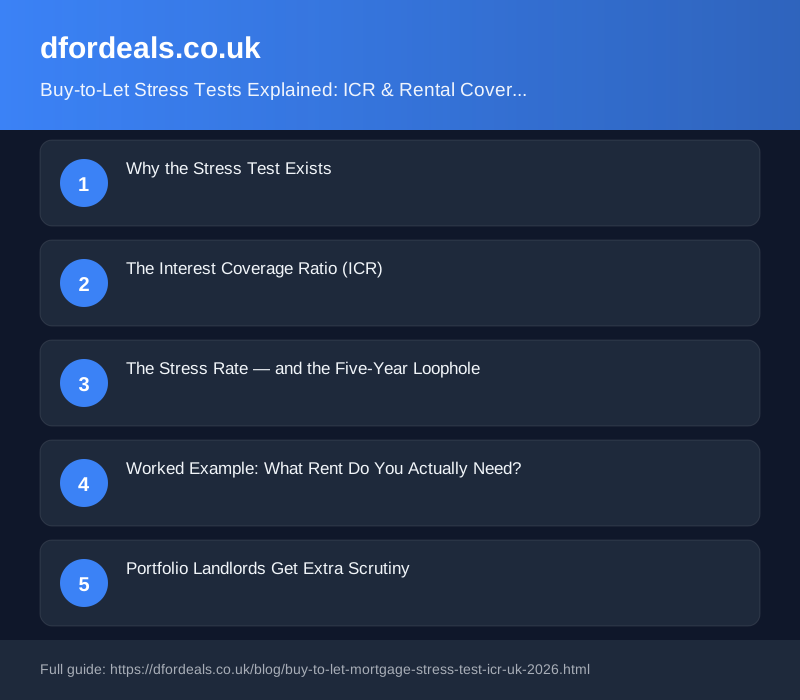 data-pin-media="https://dfordeals.co.uk/blog/images/buy-to-let-mortgage-stress-test-icr-uk-2026.png" data-pin-description="Buy-to-Let Stress Tests Explained: ICR & Rental Cover Ratios (UK 2026)" data-pin-url="https://dfordeals.co.uk/blog/buy-to-let-mortgage-stress-test-icr-uk-2026.html"
The single reason most buy-to-let applications get declined isn't a bad credit score — it's the rent not stretching far enough. Before a lender hands over a penny, it runs your deal through a "stress test": a calculation that asks whether the rent would still comfortably cover the mortgage if interest rates jumped. Get the sums wrong and a property that looks like a solid buy on paper can be rejected outright, or approved for far less than you need. Here's exactly how the buy-to-let stress test works in 2026 — the interest coverage ratios, the stress rates, the five-year-fix loophole, and the practical moves that get borderline deals over the line.
A buy-to-let stress test is the affordability check a lender uses to size a mortgage. It confirms the expected rent covers the interest by a set margin — the interest coverage ratio (ICR) — when the interest is recalculated at a higher "stressed" rate rather than the real pay rate.
Why the Stress Test Exists
Buy-to-let lending isn't a free-for-all — it's shaped by rules from the Bank of England. Since its 2016 underwriting standards, the Bank of England's Prudential Regulation Authority (PRA) has required lenders to stress-test buy-to-let affordability against a notional interest rate that reflects likely future rate rises, with a minimum expectation of around 5.5%. The logic is simple: most buy-to-let mortgages are interest-only, and most are on short fixed rates. When that fix ends, the borrower rolls onto a higher rate — and the PRA wants confidence that the rent can still cover the payments when it does.
The result is a two-part test. First, the lender decides on an ICR — how far the rent must exceed the interest. Second, it picks a stress rate — the notional interest rate the rent is measured against. Both levers move the amount you can borrow, and both changed the maths dramatically for landlords after rates rose from their 2021 lows.
The Interest Coverage Ratio (ICR)
The ICR is the cushion between rent and mortgage interest. An ICR of 125% means the rent must be at least 1.25× the (stressed) interest; 145% means 1.45×. Lenders set the ratio by the borrower's tax position, because Section 24 means higher-rate taxpayers keep less of their rent after tax:
| Borrower type | Typical ICR |
| Basic-rate taxpayer (20%) | 125% |
| Limited company / SPV | 125% |
| Higher-rate taxpayer (40%) | 145% |
| Additional-rate taxpayer (45%) | 145% |
This is one of the biggest reasons portfolio landlords have shifted to limited company (SPV) ownership: a company is taxed on profit, not turnover, so lenders apply the friendlier 125% ratio regardless of the director's personal tax band. On the same property, that can mean tens of thousands of pounds more of borrowing.
The Stress Rate — and the Five-Year Loophole
The stress rate is where deals are won and lost. Rather than testing against your actual pay rate, the lender assumes a higher one — often the higher of a fixed floor (commonly 5.5%) or your pay rate plus a margin of around 1–2%. In 2026 most two-year buy-to-let products are stressed somewhere between 5.5% and 8.5%, depending on the lender and product.
But there's a crucial carve-out. The PRA framework lets lenders apply a lower stress rate to fixed rates of five years or more, because the borrower is locked in and protected from near-term rate rises. Many lenders test five-year fixes at, or close to, the actual pay rate — which is why a deal that fails on a two-year fix can suddenly stack up on a five-year one.
Key point: The five-year fix isn't just about rate certainty — it's an affordability tool. By cutting the stress rate, it can lift your maximum loan by 20–30% on the very same rent. For a tight deal, the product term is often the difference between yes and no.
Worked Example: What Rent Do You Actually Need?
The formula is: minimum monthly rent = (loan × stress rate × ICR) ÷ 12. Take a common scenario — a £150,000 interest-only buy-to-let loan — and see how the required rent shifts as the ICR and stress rate change:
| Stress rate | ICR 125% (rent needed) | ICR 145% (rent needed) |
| 5.5% | £859/mo | £997/mo |
| 7.0% | £1,094/mo | £1,269/mo |
| 8.5% | £1,328/mo | £1,541/mo |
Read the extremes: the same £150,000 loan needs £859 a month in rent for a basic-rate borrower on a five-year fix stressed at 5.5%, but £1,541 a month for a higher-rate borrower on a short fix stressed at 8.5% — a 79% difference driven purely by tax band and product choice, not the property. That gap explains why two investors can look at the identical flat and one gets the mortgage while the other is told the rent "doesn't cover".
It also shows why rental yield and lending are joined at the hip. In a low-yield area where £150,000 buys a home renting at £850, a higher-rate borrower simply can't get that loan on a two-year fix — the numbers don't reach. In a higher-yield northern town, the same money might rent at £1,100 and clear every column in the table.
Portfolio Landlords Get Extra Scrutiny
If you own four or more mortgaged buy-to-let properties, the PRA classes you as a "portfolio landlord", and since 2017 lenders must underwrite you to a specialist standard. In practice that means:
- The whole portfolio is stress-tested, not just the property you're buying. Lenders check that your overall rent covers your overall borrowing — a typical benchmark is 145% aggregate ICR across the portfolio.
- You'll submit more paperwork — a property schedule, business plan, cash-flow forecast and often submitted accounts.
- One weak property can drag the rest, because a low-yielding or heavily mortgaged asset pulls down the aggregate cover ratio.
This is why experienced investors watch their portfolio-wide ICR, not just each deal in isolation — and why keeping a couple of low-geared, high-yield properties in the mix can keep the whole book lendable.
How to Pass the Stress Test
When a deal is tight, you have more levers than most investors realise. In rough order of impact:
- Take a five-year fix. The single most powerful move — it drops the stress rate and can lift your loan by a fifth or more on the same rent.
- Borrow through a limited company. The 125% ratio (versus 145% personally) means the same rent supports a bigger loan. Weigh it against the running costs in our SPV guide.
- Increase the deposit. A smaller loan needs less rent to cover it. Dropping from 75% to 65% loan-to-value both eases the stress test and unlocks lower rates.
- Use top-slicing. Some lenders let you count surplus personal income towards any rental shortfall, rather than failing the deal outright — useful for lower-yield, higher-value stock.
- Buy for yield, not just capital growth. A higher rent relative to price sails through the test. This is where buying below market value and targeting higher-yield areas pays off twice — once on price, once on financeability.
Where This Fits in 2026
With the Bank of England base rate off its peak but still well above the ultra-cheap money of a few years ago, stress rates remain the gatekeeper for buy-to-let borrowing. Falling product rates help, but as long as lenders stress at a floor of around 5.5% and higher-rate landlords face 145% cover, rent — not the headline mortgage rate — is what decides how much you can borrow. Model the stress test before you offer, not after your application is in, and you'll stop wasting time on deals that were never going to fund. Pair it with a clear read on your Section 24 tax position and net rental yield, and you'll know within minutes whether a property is genuinely lendable.
Frequently Asked Questions
What is a buy-to-let stress test?
It's the affordability calculation a lender uses to decide how much it will lend against a rental property. It checks that the expected rent covers the mortgage interest by a set margin — the interest coverage ratio (ICR) — when the interest is recalculated at a higher "stressed" rate rather than the real pay rate. Typical requirements are 125% cover for basic-rate taxpayers and limited companies, and 145% for higher-rate taxpayers, tested at a stress rate of roughly 5.5% to 8.5%.
What ICR do buy-to-let lenders use in 2026?
Most lenders apply a 125% interest coverage ratio for basic-rate taxpayers and limited-company (SPV) borrowers, and 145% for higher and additional-rate taxpayers. Some sit at 140% or tier the ratio by tax band. The ICR simply means the stressed rent must exceed the stressed interest by 25% or 45% respectively.
Why do lenders stress-test at a higher interest rate?
Because the Bank of England's Prudential Regulation Authority requires it. Its 2016 underwriting standards told lenders to test buy-to-let affordability against a notional rate reflecting likely future rises — a minimum expectation of around 5.5% — so borrowers can still cover the mortgage if rates climb once the fixed period ends.
How can I pass a buy-to-let stress test?
Take a five-year (or longer) fix to access a lower stress rate; borrow through a limited company for the 125% ratio; put down a larger deposit to shrink the loan; buy in a higher-yielding area so the rent covers a smaller loan more easily; or use a lender that offers top-slicing to count surplus personal income towards any shortfall.