How to Negotiate a Property Purchase Price in the UK: Buyers' Market Tactics for 2026
UK properties spent an average of 72 days on the market in mid-2026 — the longest since 2012 — and asking price reductions averaged 3.8% nationally before sale. Sellers who listed in the spring without a buyer by August have already had the conversation about price cuts and watched similar properties near them reduce twice. Property price negotiation in 2026 works by turning that seller psychology into a structured, evidence-led offer. Buyers securing 5–8% below asking price are not the most aggressive — they are the most prepared. This guide gives you the framework.
Property price negotiation is the process of arriving at a purchase price below the asking price using comparable sold prices, time-on-market data, survey findings, and buyer positioning — rather than emotional offers or arbitrary percentages. In England and Wales, no offer is legally binding until contracts are exchanged.
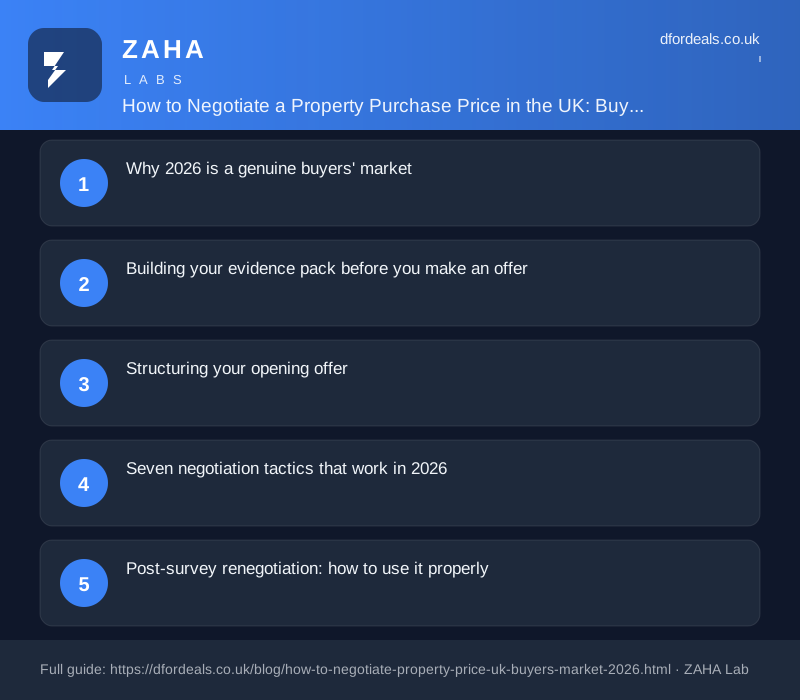
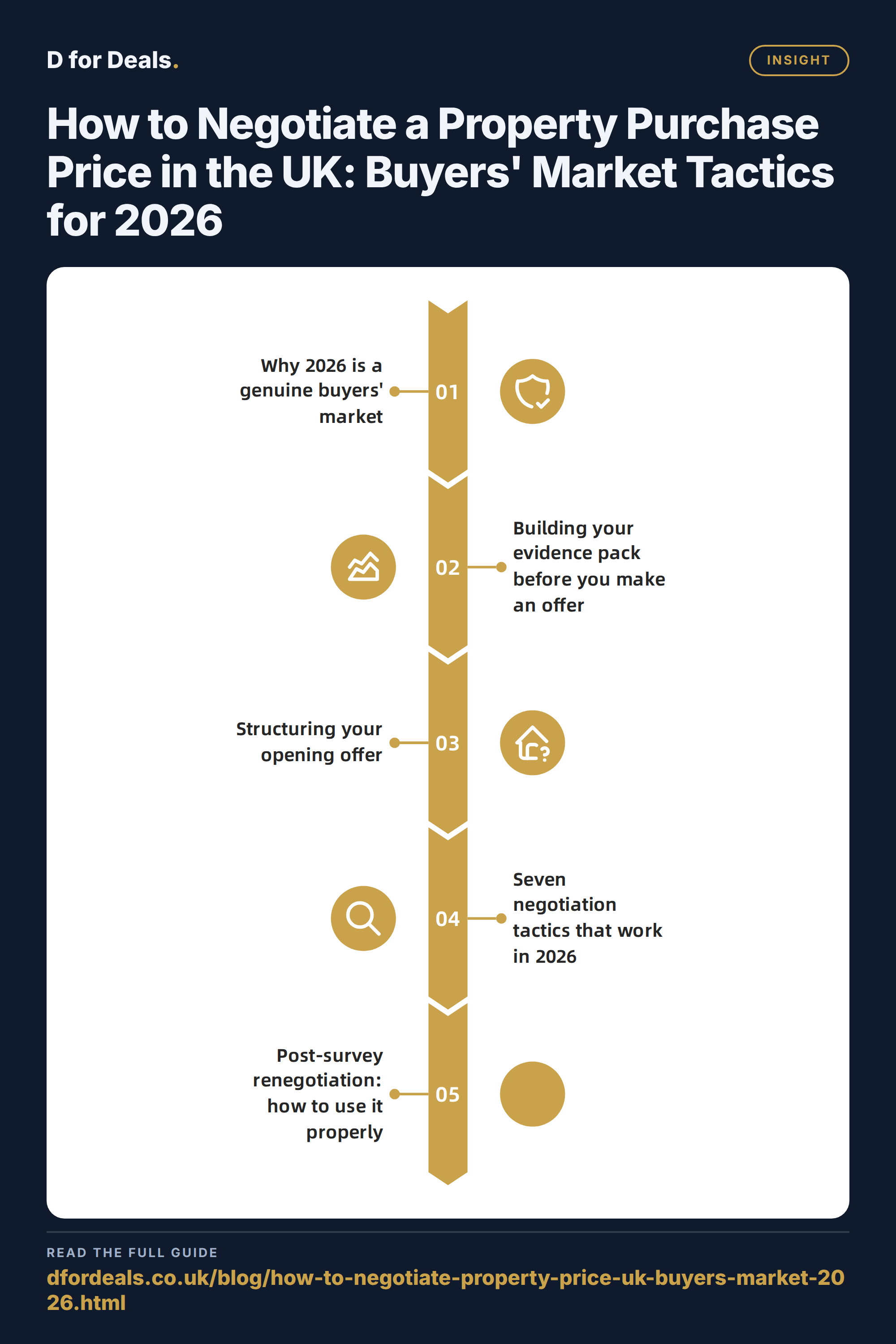
Why 2026 is a genuine buyers' market
Three structural changes have shifted negotiating power toward buyers in 2026.
Higher mortgage costs mean fewer competing buyers at any given price point. With most buy-to-let lenders stress-testing at rates above 5.5%, and owner-occupier mortgage affordability still constrained relative to 2020–2022, the pool of mortgage-financed buyers chasing any given property is smaller. Sellers who previously relied on competing offers to hold price now face thinner buyer queues.
Longer time-on-market gives buyers information. A property that has sat unsold for 60+ days is a fundamentally weaker seller position than one listed last week. Portal listing histories are publicly visible, and buyers who check them have a negotiating data point before they even visit.
Reduced transaction volumes mean fewer competing offers. UK residential property transactions fell approximately 7% year-on-year in the 12 months to May 2026, with mortgage-dependent segments particularly affected. — HM Land Registry, UK Property Transactions Statistics, May 2026. Sellers in most regions cannot rely on a competing bid to protect their asking price.
| Time on market | Typical discount achievable | Seller psychology |
|---|---|---|
| Under 14 days | 0–1% | Testing the market; expecting full price |
| 14–30 days | 1–3% | Open to discussion with comparable evidence |
| 30–60 days | 3–5% | Motivated; first offer rejected was too low |
| 60–90 days | 5–8% | Price anxiety; genuinely motivated seller |
| 90+ days | 8–12%+ | May accept below comparable survey value |
These ranges are not guarantees — they depend on local market conditions and the seller's individual circumstances. Rural and premium markets behave differently from high-volume urban corridors. Use time-on-market as a signal, not a formula.
Building your evidence pack before you make an offer
Never make an offer without comparable evidence. This is the single biggest mistake UK buyers make — they offer an arbitrary round percentage below asking without being able to justify why. Sellers and their agents hear low offers every week; what they rarely hear is a specific, documented case.
Your evidence pack should contain three things:
- Recent sold prices for comparable properties within 0.5 miles, completed in the last three months. Pull these from Land Registry data via Rightmove or Zoopla sold-price tools. Use the closest possible comparables — same bedroom count, similar condition, similar street type.
- The listing history of the property you are buying. Check Rightmove's listing history feature or third-party tools. If the asking price has already been reduced once, your opening offer should be calculated from the current asking price, not the original — the seller has already made a concession.
- Time on market expressed in days. Agents sometimes obscure this with 'just relaunched' language. Cross-reference portal listing dates to get the true figure, not the relaunched date.
Present this in writing to the agent when making your offer. "I am offering £X based on [comparable A] which completed at £Y in June and [comparable B] at £Z in July" is significantly more powerful than "I'd like to offer 5% below asking." The first requires the agent to engage with your evidence; the second is easy to brush off.
Average time-to-sale in England reached 72 days in Q2 2026, the highest figure recorded since Q3 2012, as buyer demand softened against a backdrop of persistent mortgage affordability constraints and economic uncertainty. — Rightmove UK Market Data, Q2 2026
Structuring your opening offer
Your opening offer should leave room to negotiate upward without starting so low that the seller refuses to engage at all. Starting 15% below asking on a fresh listing is almost always counterproductive. The right opening depends on time-on-market:
- 0–30 days: Open 3–4% below asking with comparable evidence
- 30–60 days: Open 5–7% below, referencing both comparables and time-on-market
- 60–90 days: Open 7–10% below; your evidence should carry the argument
- 90+ days: Use comparable sold prices — not asking price — as your ceiling
Always make your offer in writing, through the agent, on the day you view if you are genuinely interested. Verbal offers are easily dismissed. A written offer with a comparable evidence pack creates a paper trail that agents treat more seriously.
State your buyer position clearly: cash buyer or mortgage in principle held (include the lender and DIP reference if possible), solicitor instructed, no chain above you. Each of these reduces the seller's risk. Some sellers will accept a lower offer from a chain-free, proceedable buyer over a higher offer from a buyer with three links above them.
Seven negotiation tactics that work in 2026
1. Ask about the seller's timeline before you offer. Before viewing, ask the agent: "Can you tell me anything about the seller's situation or timeline?" They are trained not to reveal personal circumstances, but the response is informative. "The seller is keen to proceed quickly" is useful. A deflection or long pause is also useful.
2. Use comparable data the seller can independently verify. Vague claims that "the market is slow" are easy to dismiss. Specific Land Registry sold prices that the seller can look up themselves are harder to argue with. A good agent will share your evidence with the seller; if yours does not, ask them to.
3. Separate the price from extras. If you want fixtures included — carpets, white goods, garden furniture — negotiate them separately after agreeing price. Bundling them into your opening offer gives the seller something obvious to refuse without engaging on the price itself.
4. Let the agent be your ally, not your adversary. Estate agents work on commission — they want the deal to close. If your offer is credible and evidence-based, a professional agent will advocate for it with the seller because closing is in their interest too. Building rapport with the agent rather than treating them as an obstacle usually serves you better.
5. Make your counter-offer once. If the seller counters, think carefully before entering a long incremental back-and-forth. Making one clear final offer — "this is the maximum I can stretch to given the comparables, and here is why" — and meaning it is often more effective than ten rounds of small moves. Sellers respond to decisiveness.
6. Reference the survey process without threatening. Before any negotiation concludes, mention that you will be commissioning a survey and that the results may raise further points. This is factually true and softens the ground for a post-survey renegotiation if needed, without making it sound like a threat.
7. Be genuinely willing to walk away. The strongest negotiating position is authentic willingness to walk. If the numbers do not work at the seller's floor price, say so clearly — and mean it. Sellers who have already watched one deal fall through are often more flexible with a buyer who sets a credible ceiling than one who keeps chipping without purpose.
Post-survey renegotiation: how to use it properly
RICS homebuyer reports and full structural surveys regularly identify defects material enough to affect value. Common items in 2026 include roof condition and remaining lifespan, penetrating or rising damp, pre-17th Edition electrical installations, and historic subsidence movement — even where stable.
If your survey reveals a material issue, you are entitled to renegotiate. The standard approach: obtain two independent quotes for the remediation work, then request a price reduction equal to 50–75% of the lower quote. This leaves something for the seller and avoids the request appearing opportunistic.
- Items that support renegotiation: Surveyor ratings of 'urgent', 'requires immediate attention', or Category 3 defects under the traffic-light system
- Items that do not: Routine maintenance, 'monitor' items, cosmetic issues the buyer could see on the viewing
Make the renegotiation request promptly after receiving your survey report, in writing through your solicitor. A request made three weeks after the report, just before exchange, will be viewed with suspicion and is more likely to result in the seller withdrawing.
Mistakes that kill negotiations
- Making a verbal offer with no evidence. Easy for the agent to forget or misrepresent to the seller.
- Offering too low with no justification. Sellers sometimes refuse all future offers from a buyer who opened insultingly low, even at a later and reasonable price.
- Revealing your maximum budget to the agent. Agents are legally required to pass material information to the seller. Your ceiling is material information.
- Delaying after agreeing price. Slow conveyancing is the fastest way to lose a deal you negotiated hard to win. Instruct your solicitor the same week you agree terms.
- Using the survey to renegotiate opportunistically. If you intend to renegotiate regardless of findings, sellers and agents will recognise the pattern. Do it once, with genuine evidence, or not at all.
Quick-reference: negotiation by situation
| Situation | Recommended approach |
|---|---|
| Property under 30 days on market | Open 3–4% below; lead with comparable evidence |
| Property 30–90 days on market | Open 5–8% below; cite time-on-market and comparables |
| Property 90+ days on market | Use comparable sold prices as your price ceiling, not asking |
| Asking price already reduced | Calculate offer from current asking price; reduction is a concession already given |
| Survey reveals material defect | Get two quotes; request 50–75% of lower quote as reduction |
| Seller refuses all movement | Counter once clearly; state your ceiling; be prepared to walk |
Frequently asked questions
How much below asking price should I offer in 2026?
The right discount depends on time-on-market and comparable sold prices, not a fixed percentage. For properties under 30 days on the market, 3–4% below is a reasonable opening with evidence. For properties on the market 60–90 days, 6–8% is defensible. For 90+ days, comparable sold prices — not asking price — should set your ceiling.
How do I find comparable sold prices to support my offer?
Land Registry publishes all residential sold prices, searchable via Rightmove and Zoopla sold-price tools. Use properties sold in the last three months, within 0.5 miles, with the same bedroom count and similar condition. For higher-value purchases where comparables are limited, a RICS comparable valuation from a registered valuer costs around £200–350 and provides a formal basis for your offer.
Can I renegotiate the price after my survey?
Yes, where the survey reveals material defects. Obtain two independent remediation quotes and request a reduction equal to 50–75% of the lower quote. Use the surveyor's own severity language — items marked 'urgent' support a renegotiation; 'monitor' items generally do not. Make the request promptly and in writing.
Should I reveal my maximum budget to the estate agent?
No. Estate agents are legally required to pass material information to sellers. Your maximum budget is material information. State that you are motivated and have a ceiling that reflects the comparable evidence, without specifying a number until you are genuinely at your limit.
How long should a property be on the market before I offer below asking?
Leverage increases meaningfully after 30 days and significantly after 60 days. Check portal listing history to confirm the true time-on-market — agents sometimes relaunch listings at the same price to reset the displayed date without actually reducing. Cross-reference the portal listing date against the rightmove sold-price history to verify when the property was first listed.
This article is for educational purposes and does not constitute financial or legal advice. Property negotiation outcomes vary significantly by market, property condition and individual circumstances. Always instruct a RICS-regulated surveyor and a qualified conveyancing solicitor before proceeding with any purchase.