Portfolio Landlord Rules Explained: How UK Lenders Assess 4+ Property Borrowers (2026)

Miss three BTL mortgages and you are just a landlord. Pick up a fourth and lenders are legally required to assess every property you own — not just the one you are trying to buy. The Bank of England's Prudential Regulation Authority (PRA) introduced this rule in September 2017, and it catches more growing landlords off guard than almost any other mortgage requirement. If you are planning to scale beyond three properties, here is exactly what to expect.
Short answer: Portfolio landlord status — triggered by owning four or more mortgaged buy-to-let properties — requires lenders to apply specialist underwriting across your entire portfolio. They assess aggregate rental income against aggregate mortgage debt, request a full property schedule and often a business plan, and apply stricter interest coverage ratio (ICR) tests than they would for a single property. Not all lenders will accept portfolio applications at all.
Portfolio landlord (UK definition): A borrower who has, or will have upon completion of the proposed mortgage, four or more mortgaged buy-to-let properties across all lenders. Defined by the PRA in its September 2017 underwriting standards. Lenders must apply enhanced underwriting to the entire portfolio, not just the new property being financed.
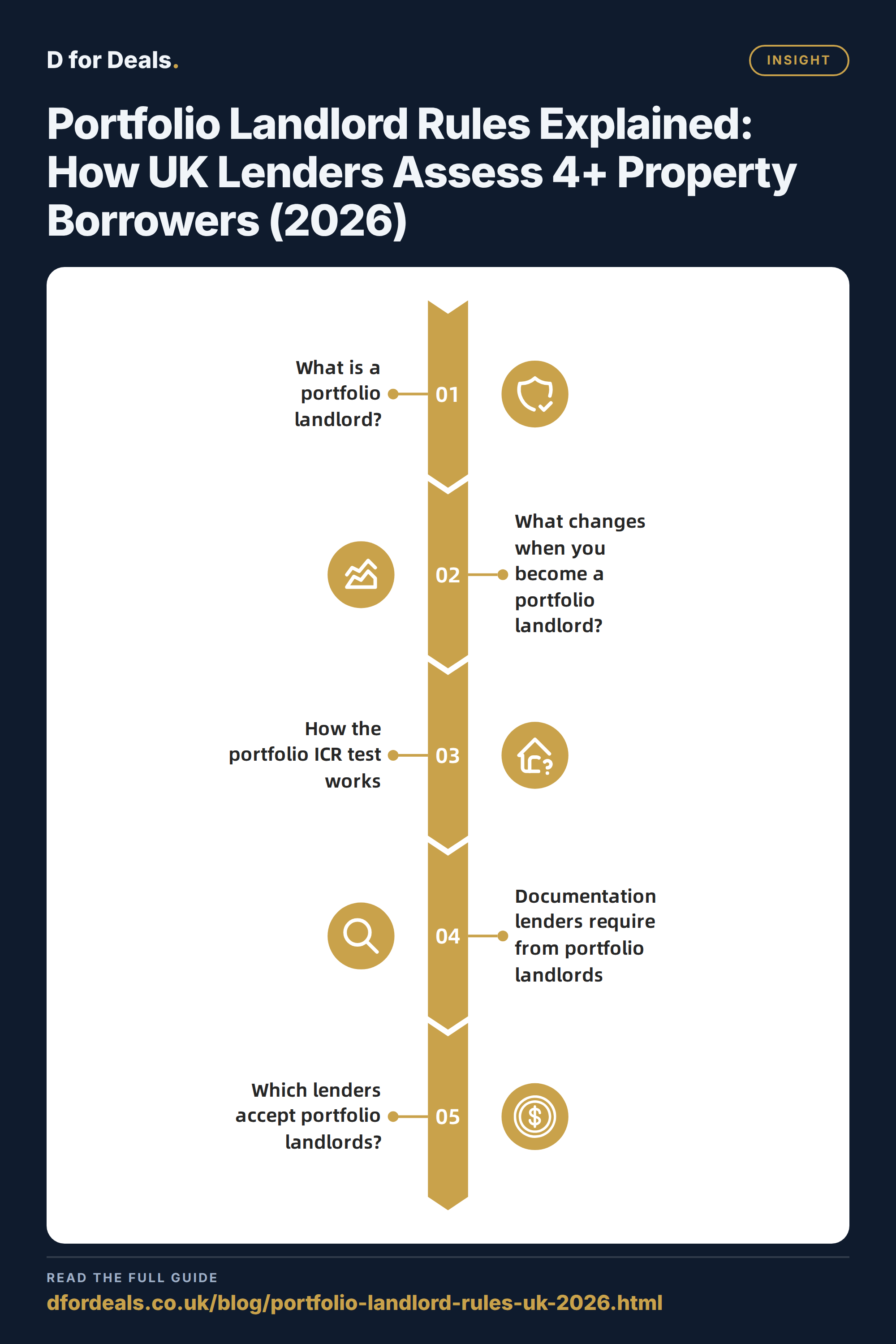
What is a portfolio landlord?
The PRA's definition is precise: you become a portfolio landlord the moment your total count of mortgaged buy-to-let properties reaches four — including the one you are applying to finance. This applies across all lenders simultaneously. So if you have three properties with one lender and apply for a fourth with a different one, the new lender treats you as a portfolio landlord from the outset of that application.
Crucially, properties held in a limited company (special purpose vehicle, or SPV) generally count toward the total, as do properties held jointly. If you own two properties solely and two jointly with a partner, you likely meet the threshold. A handful of lenders also include unencumbered (mortgage-free) investment properties in the count, though this goes beyond the PRA's core requirement.
There is no minimum portfolio value. A landlord with four terraced houses in the North of England worth £80,000 each qualifies just as much as one with four flats in central London. The threshold is a simple count of mortgaged BTL properties, nothing else.
What changes when you become a portfolio landlord?
The PRA requires lenders to apply specialist underwriting to portfolio applications. In practice, this means four material differences from a standard single-BTL mortgage application:
- Background portfolio assessment. The lender reviews your entire portfolio — not just the property you want to mortgage. They request a property schedule listing every BTL address, outstanding mortgage balance, current lender, monthly rent and remaining lease term (for leasehold properties).
- Portfolio-level ICR test. Standard BTL underwriting checks that the new property's rent covers the stress-tested mortgage payment at the required ratio. Portfolio underwriting stacks all your properties together and applies a similar stress test to the combined rental income and combined debt service.
- Additional documentation. Most lenders ask for two years of SA302 returns or company accounts, three to six months of bank statements, and a written asset-and-liability statement. Many also require a business plan or profit-and-loss summary covering the whole portfolio.
- Lender selection narrows. Some lenders — particularly high-street banks — simply do not accept portfolio applications. This makes lender research essential before you apply, since declined applications leave hard searches on your credit file.
How the portfolio ICR test works
Interest coverage ratio (ICR) is the core stress test: it measures whether your rental income is sufficient to cover the mortgage interest at a stressed rate, with a safety margin on top. For portfolio landlords, this test operates at the aggregate level.
Worked example
Suppose you already own three properties and are purchasing a fourth:
| Property | Mortgage balance | Monthly rent |
|---|---|---|
| A, B, C (existing) | £540,000 combined | £2,900 combined |
| D (new purchase) | £180,000 | £1,000 |
| Portfolio total | £720,000 | £3,900/month (£46,800/yr) |
At a 5.5% stress rate on £720,000 total debt: annual stress-tested interest = £39,600.
Portfolio ICR = £46,800 ÷ £39,600 = 1.18x
Most lenders require a minimum of 1.25x (basic-rate taxpayer) or 1.45x (higher-rate taxpayer). This portfolio, as structured, fails the test. The investor's options are to reduce the loan-to-value on property D, raise rents where possible, or find a lender using a lower stress rate.
Note that actual stress rates and ICR thresholds vary by lender. Many now use the pay rate plus 2% rather than a fixed 5.5% floor, which materially changes outcomes when product rates are low.
Documentation lenders require from portfolio landlords
| Document | Standard BTL | Portfolio landlord |
|---|---|---|
| Rental income evidence (AST) | Yes, new property only | Yes, all properties |
| Full property schedule | No | Yes — all BTL addresses and mortgage details |
| SA302 / tax returns | Varies | Usually 2 years required |
| Asset and liability statement | Rarely | Standard requirement |
| Business plan or P&L | No | Most lenders request this |
| Background portfolio ICR | No | Yes — all properties stress-tested together |
Sources: UK Finance, lender product guides (Paragon, TMW, Foundation Home Loans, Fleet Mortgages). Specific requirements vary; verify with the lender or a specialist BTL broker before applying.
Which lenders accept portfolio landlords?
The specialist BTL sector is the primary destination for portfolio landlords. As of mid-2026, lenders commonly cited as active in this segment include Paragon Bank (which was built from the ground up to serve landlords with larger portfolios), The Mortgage Works (TMW, the BTL arm of Nationwide), Fleet Mortgages, Foundation Home Loans, and Aldermore.
Most high-street banks have substantially reduced their appetite for portfolio applications. This matters because specialist lender rates are typically slightly above mainstream BTL rates — though the gap has narrowed considerably as competition among specialist lenders has increased and the Bank of England base rate has moved.
According to data published by UK Finance, portfolio landlords (four or more properties) account for approximately 17% of UK landlords by count but hold over half of total private rental stock by volume. This makes the segment commercially important for specialist lenders, even if mainstream banks have stepped back.
How Section 24 compounds the challenge
Higher-rate taxpayers who own properties in personal names face a compounding problem at the portfolio landlord stage. Section 24 — the mortgage interest relief restriction fully phased in since April 2020 — means mortgage interest costs can no longer be deducted from rental income before tax for personal-name landlords. This reduces taxable profit but, more relevantly for mortgage applications, it reduces the net rental income reflected on SA302 returns.
Lenders that apply a 145% ICR for higher-rate taxpayers are building in a larger buffer precisely because Section 24 erodes actual cash flow. A basic-rate landlord and a higher-rate landlord with identical portfolios can face materially different maximum loan sizes as a result.
This dynamic is one reason many investors restructure into a limited company (SPV) before reaching four properties. However, transferring existing properties into a company typically incurs stamp duty land tax on market value and may trigger capital gains tax — costs that can make restructuring uneconomic for an established portfolio. Taking specialist tax advice before purchase three is considerably cheaper than doing so after purchase five. See our Section 24 explainer and limited company BTL guide for detail.
Practical strategies for portfolio landlords
Run the portfolio ICR before you agree a price
The most common mistake is calculating affordability on the new property alone, then discovering at mortgage application that the portfolio-level test fails. Model the combined position — all existing debt, all existing rents, plus the new property — before committing to a purchase. If the ICR is marginal, you have time to adjust the LTV, choose a higher-yielding property, or identify the right lender.
Maintain a current property schedule
Every lender will ask for one. A clean spreadsheet listing each BTL's address, current lender, outstanding balance, monthly rent, lease expiry and EPC rating saves time at application and signals that you run your portfolio professionally. Build this habit from property two — not property four.
Use a specialist BTL broker
Portfolio applications are meaningfully more complex than standard BTL. A whole-of-market specialist BTL broker can match your portfolio structure to the lender most likely to approve, without leaving a trail of hard searches across your credit file. Given that lender criteria differ significantly on how they count properties, stress rates and documentation requirements, this is one area where broker expertise delivers clear value.
Factor in the EPC trajectory
The government's proposed minimum EPC C rating for new tenancies — expected to apply from 2028 onwards — is already influencing how lenders view portfolio risk. Some lenders are beginning to apply lower maximum loan-to-values on sub-C properties, treating them as higher-risk assets within a portfolio assessment. A portfolio with multiple D- or E-rated properties may face tighter criteria than one with predominantly C-rated stock.
Key numbers to know
- 4 properties: the PRA portfolio landlord threshold (effective September 2017)
- 125% / 145%: standard ICR thresholds for basic-rate / higher-rate taxpayers
- 5.5%: common stress rate floor used by mainstream specialist lenders; many now use pay rate + 2%
- ~17%: share of UK landlords with four or more properties (NRLA / HMRC data)
- 50%+: share of private rental stock held by portfolio landlords (UK Finance estimate)
Frequently asked questions
What is a portfolio landlord in the UK?
A portfolio landlord is defined by the Prudential Regulation Authority as a borrower who has, or will have upon completion, four or more mortgaged buy-to-let properties across all lenders. The rule has applied since September 2017 and requires lenders to use specialist underwriting — assessing the entire portfolio, not just the new property.
Do properties in a limited company count toward portfolio landlord status?
Yes, in most cases. The PRA's guidance requires lenders to include properties held in SPVs (limited companies) in the portfolio count. Properties owned jointly with others also typically count. A small number of lenders further include mortgage-free investment properties, but this is their own policy rather than a PRA requirement.
What documents do lenders require from portfolio landlords?
Expect to provide a full property schedule (every BTL address, lender, balance and rent), two years of SA302 returns or company accounts, three to six months of bank statements, an asset-and-liability statement, and often a written business plan or profit-and-loss summary. Requirements vary by lender; some are more demanding than others.
What ICR thresholds apply to portfolio landlords?
Most lenders apply 125% for basic-rate taxpayers and 145% for higher-rate taxpayers, stress-tested at either 5.5% or the product pay rate plus 2% — whichever is higher. This test is applied to the aggregate portfolio, meaning one underperforming property can drag down the whole application.
Can portfolio landlords still get competitive mortgage rates?
Yes. Specialist lenders — Paragon, TMW, Fleet Mortgages, Foundation Home Loans — compete actively for portfolio business. Rates are typically marginally above standard BTL, but the gap has narrowed in recent years. Using a specialist BTL broker gives access to the full range of options without creating multiple hard credit searches.
This article is for educational purposes and does not constitute financial or mortgage advice. Mortgage criteria change frequently — always verify current requirements directly with lenders or a qualified mortgage broker authorised by the Financial Conduct Authority.